


NexGen BAS / BMS for Buildings
The BAS / BMS module is the supervisory control layer of NexGen Smart Buildings. It connects building systems, HVAC, hydronic plants, ventilation, lighting, plug-load strategies, domestic water subsystems, and select safety/monitoring interfaces into a unified management framework with defined sequences, measurable performance targets, and commissioning-ready acceptance criteria. The objective is not “controls in general.” It is a controls architecture that makes an energy-independent building operable: stable comfort, predictable energy behavior, reliable alarms, and traceable operating records.
BAS/BMS integrates directly with IAQ + Environmental Sensing, Microgrid + Controls, Energy Storage, Digital Twin + Analytics, and Cybersecurity + Data Governance. The result is a coordinated operating system where occupancy modes, ventilation demand, temperature resets, and load-shed behaviors are explicit, testable, and verifiable over time—so the building remains measurable and tunable after turnover, not “black-boxed” by vendor defaults.
Systems Library
NexGen buildings are engineered as integrated systems. Explore the energy, controls, sensing, digital twin, and security modules that can be combined into an energy-independent smart building.

On-site wind generation integrated into the building’s energy system to reduce grid dependence and support resilient operations.

Roof and site photovoltaics paired with controls to deliver clean power and predictable performance.

Battery and storage strategies that smooth peaks, increase resilience, and enable islanding when needed.

A coordinated microgrid architecture that manages generation, storage, loads, and grid interaction in real time.
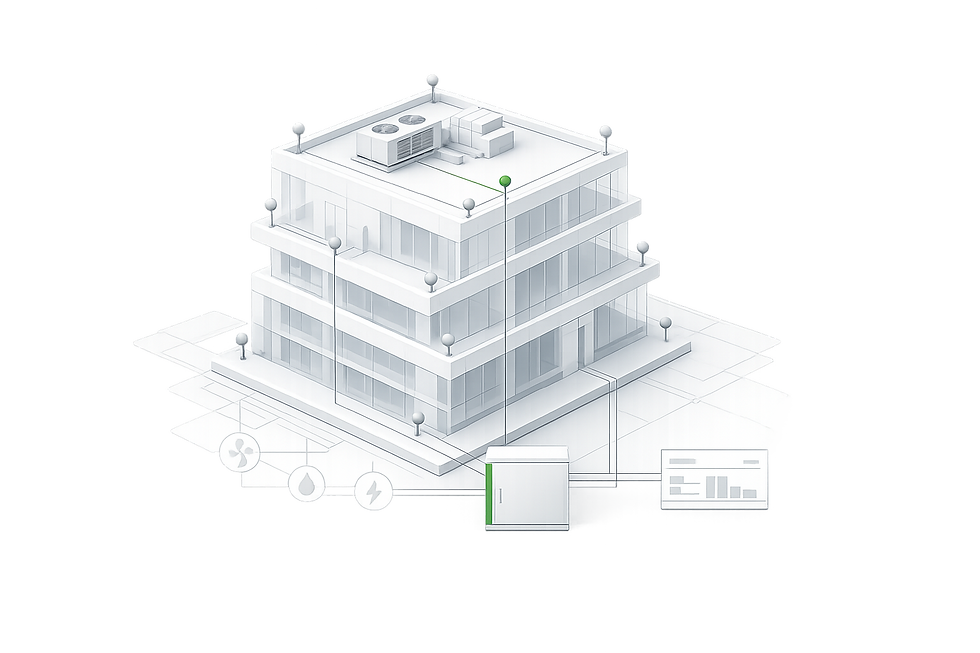
Controls-ready integration that connects building systems, sensors, and equipment into a unified management layer.

Continuous monitoring of air quality and comfort signals to improve health, performance, and operational response.

A twin-ready model connected to live data for visibility, diagnostics, and performance optimization over time.

Secure, permissioned data architecture with auditability to protect systems, users, and lifecycle records.

Automation pathways for inspection, maintenance, and operations—designed to integrate safely with building systems and workflows.

Functional Scope (What BAS / BMS Does)
Primary functions (project-dependent):
-
Supervisory control + sequencing
Defined sequences of operation for building systems and equipment groups (start/stop, staging, interlocks, safeties, and resets) aligned with design intent and operational constraints.
-
HVAC system coordination
Airside + waterside logic across zones and plants: setpoint management, economizer enable/disable intent, valve/damper behaviors, staging rules, and stability constraints.
-
Ventilation + IAQ response control
Demand-driven ventilation strategies driven by measured IAQ signals (project-defined), including response tiers, purge logic, and energy-aware ventilation behavior.
-
Scheduling + operating mode management
Occupied/unoccupied, warm-up/cool-down, setback/setup, after-hours requests, event modes, and tenant/space schedules (project-defined) with clear override hierarchy.
-
Alarm management + fault readiness
Alarm routing logic, prioritization, acknowledgment workflows, and exception capture (including “nuisance reduction” strategies) so operators get actionable signals—not noise.
-
Energy coordination with Microgrid + Controls
BAS/BMS demand-limiting and discretionary-load strategies coordinated with microgrid constraints: peak avoidance, shed/restore sequencing, restart behavior, and equipment lockout windows during grid events or island-ready operation (where applicable).
-
Measurement + verification readiness
Time-synced trends, clear point naming, historian requirements, and KPI definitions that support functional testing, commissioning documentation, and continuous verification.
Controls Logic and Operating Modes
BAS/BMS behavior is defined by sequences, constraints, and override hierarchy. Controls typically address:
-
Occupancy logic + schedule governance
What is enabled when, and why—across zones, tenants, and special-use rooms—plus after-hours workflows and exception handling. -
Setpoint resets + optimization loops
Supply air temperature resets, static pressure resets, chilled/hot water resets, and ventilation reset strategies tied to measurable triggers and guardrails (project-defined). -
IAQ-driven ventilation tiers
Threshold-based behavior (monitor → respond → escalate), including filtration/ventilation adjustments, purge windows, and return-to-normal criteria with logging. -
Load management modes (energy constraints)
Peak-period strategies, preconditioning windows, discretionary load lockouts, and restart sequencing to prevent inrush peaks and unstable cycling—especially when coordinated with Microgrid + Controls. -
Safety interlocks + “do no harm” rules
Defined interlocks for equipment protection (freeze, high temp, low flow, smoke control interfaces where applicable), plus explicit “safe state” behaviors. -
Degraded-mode behavior
Defined response under partial sensor failure, comms loss, controller loss, or device faults (fail operational vs fail safe—project-defined), including alarm routing and recovery steps.
Design Inputs (Feasibility and Engineering Constraints)
BAS/BMS feasibility and performance are driven by measurable inputs:
-
Program + zoning strategy
Occupancy patterns, space types, zoning intent, ventilation requirements, and critical rooms that drive control complexity and sensor placement. -
System inventory + controllability
Airside systems, hydronic plants, terminal devices, lighting control boundaries, metered loads, and equipment interfaces that define what can be supervised and how. -
Sequences of operation intent
Mode definitions, reset strategies, interlocks, permissives, and operating envelopes that become testable requirements (not “assumptions”). -
Sensor + metering package
What is sensed, where, at what resolution, and at what calibration/maintenance expectation—because “no sensor” means “no control.” -
Controls network + protocol architecture
Controller topology, integration boundaries, gateway needs, time sync requirements, and historian/data retention intent (including third-party integration strategy). -
Cybersecurity + governance constraints
Segmentation requirements, identity/access controls, logging requirements, patch/firmware expectations, and the data ownership/retention model for lifecycle operation.
These inputs are established during Discovery + Feasibility and form the basis for point lists, sequences, operating envelopes, and commissioning acceptance criteria.
Commissioning and Verification
BAS / BMS is commissioned as an integrated building subsystem with defined acceptance criteria.
Commissioning scope typically includes:
-
Point-to-point verification
Status, commands, alarms, setpoints, calibration checks (as applicable), time sync, historian capture, and graphics correctness. -
Sequence verification
Functional testing of key sequences (airside, waterside, zone control, schedules, resets) with documented expected outcomes. -
Mode verification
Occupied/unoccupied, warm-up/cool-down, setback/setup, event modes, and microgrid-coordinated demand modes (where applicable). -
Alarm + exception verification
Alarm routing, prioritization, acknowledgment workflow, lockouts/safes, nuisance reduction rules, and recovery criteria. -
Trend + KPI validation
Trend completeness, sampling rules, KPI math validation, exception flag logic, and baseline capture for seasonal comparison.
Acceptance criteria examples:
-
Verified occupancy modes, setpoint resets, and stable control behavior (no uncontrolled short-cycling).
-
Verified IAQ response tiers with documented triggers, actions, and return-to-normal criteria.
-
Verified demand-limiting / shed / restore sequences coordinated with Microgrid + Controls (project-dependent).
-
Validated trend completeness, time sync, alarm routing, and operator workflow usability.
-
Verified degraded-mode responses under defined failure scenarios (sensor loss, comms loss, device fault).
Digital Twin Deliverables
BAS/BMS operation is tracked as an auditable subsystem:
-
Mode history
Occupied/unoccupied and special operating modes, including timestamps and transition triggers. -
Trend histories (critical points)
Temperatures, pressures, flows, valve/damper commands, fan speeds, ventilation rates (project-defined), with time sync and retention rules. -
Alarm + fault histories
Alarms, lockouts, safeties, device faults, comms loss events, and categorized exceptions. -
Setpoint + override histories
Setpoint changes, operator overrides, automatic reset behavior, and override expiration tracking. -
KPI dashboards
Comfort stability indicators, IAQ indicators (project-defined), energy-driving behaviors (runtime, resets, simultaneous heat/cool flags), and availability/uptime of critical subsystems.
Process
BAS/BMS in NexGen is implemented as a coordinated architecture + MEP + controls workflow that turns building systems into stable, controllable environments with verifiable operating records. The process begins with Controls Narrative + Operating Intent, where occupancy modes, zoning intent, ventilation behavior, reset strategies, and safety interlocks are defined as measurable requirements. Next, Points + Integration Mapping establishes the control boundaries between equipment, subsystems, sensors, meters, third-party interfaces, and the supervisory layer—so responsibilities are explicit and testable.
Sequences of Operation + Constraints then define how systems behave across modes: scheduling, setbacks, warm-up/cool-down, IAQ response tiers, plant staging rules, demand-limiting behaviors, and degraded-mode responses. In Commissioning Scenarios + Verification, the system is tested against defined scenarios (mode transitions, alarms, IAQ triggers, shed/restore behavior, recovery, logging completeness) and acceptance criteria.
Finally, Digital Twin + KPI Reporting converts verified telemetry and event logs into dashboards and histories so performance remains measurable over time and tuning does not destroy traceability. Across all stages, the system produces consistent outputs: point lists, sequences, graphics requirements, alarm matrices, trend requirements, KPI definitions, and operations-ready logs.

Case Studies
BAS / BMS Integration Across NexGen Prototypes
(Operational Use-Cases)
OpDez integrates BAS/BMS across the NexGen prototype library as an operationally repeatable pathway—so each concept is designed from day one with defined sequences, mode behavior, IAQ response logic, microgrid-coordinated load strategies, and Digital Twin–ready telemetry/event outputs that support real-world operations. BAS/BMS is treated as the “operational truth layer” for occupant comfort and system behavior: it governs how the building breathes, heats/cools, schedules, alarms, and responds to constraints—so outcomes can be commissioned, validated, and continuously verified.
*Proprietary uses not listed

Bird Feather
BAS / BMS Use-Cases
-
Mixed-use mode governance: separate operating modes and schedules for base commercial, shared amenities, and residential/tenant zones (project-defined).
-
High-rise HVAC stability: pressure/flow and reset strategies designed to reduce cycling and preserve comfort across stacked zones.
-
IAQ response tiers: measurable triggers for ventilation escalation and recovery with logging for verification.
-
Microgrid-coordinated demand behavior: BAS/BMS demand modes that align discretionary loads with site peak limits and energy constraints.
-
Alarm governance: structured alarms for core MEP systems with prioritized routing and nuisance reduction.

Sky Lotus
BAS / BMS Use-Cases
-
Variable occupancy control: schedules and after-hours workflows tuned to real use patterns to reduce wasted runtime.
-
Ventilation optimization: demand-driven ventilation logic aligned with measured IAQ signals (project-defined) and energy constraints.
-
Plant and zone coordination: staged heating/cooling behavior with defined guardrails to avoid instability.
-
Trend completeness: time-synced trends and exception flags designed for seasonal comparison and continuous verification.

Cobra
BAS / BMS Use-Cases
-
Compact high-rise control logic: explicit sequencing for dense floorplates where coincident loads and thermal swings are common.
-
Reset strategies: supply air/static pressure and water temperature resets designed to reduce peak demand without comfort collapse.
-
Load-shed coordination: discretionary load lockouts and restart sequencing aligned with Microgrid + Controls signals (project-dependent).
-
Fault readiness: alarms and exceptions structured for troubleshooting and KPI reporting, not just “red lights.”

Double Cobra
BAS / BMS Use-Cases
-
Multi-program orchestration: BAS/BMS mode logic that preserves comfort while separating program demands (residential + commercial + amenities).
-
Staged restore sequencing: restart behavior designed to avoid inrush peaks and short-cycling after events or curtailment.
-
IAQ + comfort governance: measurable ventilation and comfort targets with logging for verification.
-
Audit-ready outputs: mode states, overrides, alarms, and KPIs maintained for lifecycle traceability.

Falcon Eye
BAS / BMS Use-Cases
-
High-reliability operations: conservative sequences and alarm governance for mission-critical or high-consequence spaces (project-defined).
-
Degraded-mode behavior: defined responses under sensor loss, comms loss, or device faults with explicit recovery steps.
-
Cyber-aligned controls: segmented controls architecture with logging and controlled access aligned with governance intent.
-
Continuous verification: KPI dashboards focused on uptime/availability and exception flags for operational readiness.

Cloud Machine
BAS / BMS Use-Cases
-
Equipment-driven stability: sequences tuned for cyclic/ramping loads and equipment-heavy environments (project-defined).
-
Mode management: disturbance handling and recovery behavior defined for continuity of prioritized operations.
-
IAQ response + logging: threshold-triggered ventilation/filtration behavior with evidence-ready histories.
-
Commissioning validation: point-to-point, sequences, alarm routing, and trend integrity verified against acceptance criteria.

Urban Stream
BAS / BMS Use-Cases
-
Office-centric scheduling: predictable occupied/unoccupied behavior with after-hours requests and exception logging.
-
Demand limiting: reduce daily peaks through setpoint resets, runtime governance, and microgrid-coordinated demand modes (project-dependent).
-
Comfort stability: sequences designed to prevent short-cycling and comfort drift across typical workday swings.
-
KPI reporting: trend completeness and exception flags maintained for lifecycle tracking and tuning.

NOAH
BAS / BMS Use-Cases
-
Resilience-first operating profile: conservative sequences built around continuity intent, redundancy, and stability constraints (project-defined).
-
Priority-space governance: explicit control rules for critical rooms and essential systems, including override hierarchy and lockouts.
-
Event governance: alarms, safeties, and recovery criteria structured for auditability and operations continuity.
-
Evidence-based operations: mode histories, overrides, alarms, and KPI outputs retained for verification over time.
