


NexGen Wind Power for Buildings
The Wind Energy module provides on-site electrical generation as part of the NexGen energy stack. Wind is treated as a variable renewable resource that must be stabilized through power electronics, controls, storage coordination, and protective relays to operate safely in both grid-connected and islanded (microgrid) modes.
This module integrates with Microgrid + Controls, Energy Storage, BAS/BMS, Digital Twin + Analytics, and Cybersecurity + Data Governance to support measurable performance and verifiable operations.
Systems Library
NexGen buildings are engineered as integrated systems. Explore the energy, controls, sensing, digital twin, and security modules that can be combined into an energy-independent smart building.

On-site wind generation integrated into the building’s energy system to reduce grid dependence and support resilient operations.

Roof and site photovoltaics paired with controls to deliver clean power and predictable performance.

Battery and storage strategies that smooth peaks, increase resilience, and enable islanding when needed.

A coordinated microgrid architecture that manages generation, storage, loads, and grid interaction in real time.
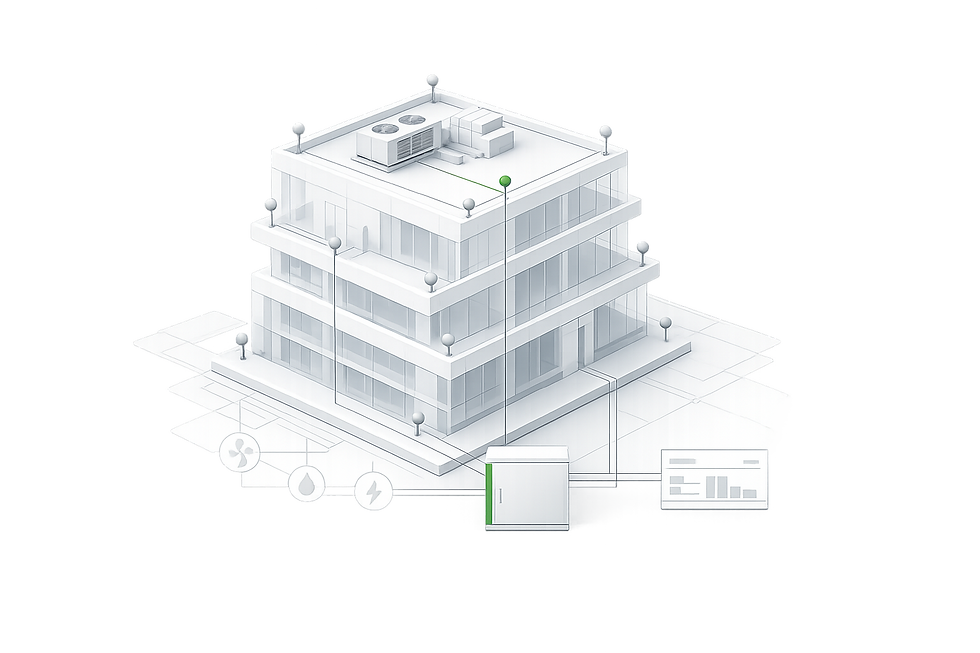
Controls-ready integration that connects building systems, sensors, and equipment into a unified management layer.

Continuous monitoring of air quality and comfort signals to improve health, performance, and operational response.

A twin-ready model connected to live data for visibility, diagnostics, and performance optimization over time.

Secure, permissioned data architecture with auditability to protect systems, users, and lifecycle records.

Automation pathways for inspection, maintenance, and operations—designed to integrate safely with building systems and workflows.
Nexgen Power for Buildings
The Wind Energy module provides on-site electrical generation as part of the NexGen energy stack. Wind is treated as a variable renewable resource that must be stabilized through power electronics, controls, storage coordination, and protective relays to operate safely in both grid-connected and islanded (microgrid) modes.
This module integrates with Microgrid + Controls, Energy Storage, BAS/BMS, Digital Twin + Analytics, and Cybersecurity + Data Governance to support measurable performance and verifiable operations.
Functional Scope
Primary functions (project-dependent):
-
Energy production (wind-to-electrical conversion): generator output conditioned through inverter/rectifier systems; power quality managed at the point of interconnection.
-
Microgrid coordination: dispatch logic coordinated with storage and solar; curtailment controls to maintain stability and protect equipment.
-
Operational modes: grid-parallel operation with export-limiting or net-metering constraints; islanded operation support (where permitted) with microgrid controller sequencing.
-
Condition monitoring: turbine performance monitoring (power curve validation, yaw/pitch behavior, fault codes) and mechanical health indicators (vibration, temperatures, status).
Integration Interfaces
Typical interface requirements:
-
Microgrid + Controls: dispatch, setpoints, ramp-rate limits, curtailment, islanding logic
-
Energy Storage: smoothing, ride-through support, charge/discharge coordination, black-start support (where applicable)
-
BAS/BMS: operational status, alarms, maintenance modes, operator visibility
-
Digital Twin + Analytics: telemetry ingestion, energy attribution, trend analysis, fault history
-
Cybersecurity + Data Governance: network segmentation, identity/access control, logging, patch governance
Controls Logic and Power Quality
Wind output is inherently variable. Controls address:
-
Voltage/frequency support (as applicable to local grid/interconnection requirements)
-
Ramp-rate management to reduce transient impacts on sensitive loads
-
Curtailment strategy under high winds, overproduction, grid constraints, or storage saturation
-
Fault response with safe shutdown, reconnection logic, and lockout conditions
-
Export limiting to comply with interconnection agreements and site electrical constraints
Siting and Technical Constraints (Design Inputs)
Wind feasibility is driven by measurable inputs:
-
Site wind regime and turbulence intensity
-
Obstructions, setbacks, noise constraints, zoning constraints
-
Structural anchorage requirements and vibration isolation strategy
-
Maintenance access, safe clearances, and serviceability
-
Utility interconnection, protection, and metering requirements
These inputs are established in Discovery + Feasibility and set boundary conditions for generation estimates and operational modeling.
Commissioning and Verification
Wind is commissioned as a power subsystem, not only “installed.”
Commissioning scope typically includes:
-
Electrical verification (disconnects, grounding, labeling, protective devices)
-
Controls verification (startup/shutdown sequences, curtailment logic, alarm handling)
-
Microgrid scenario testing (grid-parallel behavior, islanding constraints, fail-safe behavior)
-
Telemetry validation (time sync, signal accuracy, historian logging, dashboard correctness)
-
Performance verification against expected operating ranges (site-adjusted production envelope)
Acceptance criteria examples:
-
Verified safe shutdown under faults and high-wind conditions
-
Verified export limits and protection behavior
-
Validated telemetry completeness and alarm routing
-
Verified operating stability during normal site load variability
Digital Twin Deliverables
Wind performance is tracked as an auditable subsystem:
-
Real-time generation (kW) and energy (kWh)
-
Availability and downtime tracking
-
Alarm/fault history with event context
-
Trend analytics (capacity factor, seasonal patterns, exceptions)
-
Maintenance log integration (inspections, work orders, parts)

Process
Wind Energy in NexGen is implemented as a renewable generation subsystem with a defined functional workflow that converts variable wind resource into conditioned electrical output, coordinated dispatch, and auditable operational performance.
The process begins with Wind Resource + Siting Validation, where wind regime, turbulence, obstructions, setbacks, zoning/noise constraints, and service access establish feasibility and the site-adjusted production envelope. Next, Turbine + Electrical Architecture integrates the turbine and balance-of-system equipment (inverter/rectifier, metering, protective relays) so power quality is managed at the point of interconnection and export limits comply with site/grid constraints. Microgrid + Controls Coordination then applies ramp-rate limits, curtailment logic, and sequencing for grid-parallel operation (including export-limiting/net-metering constraints) and islanded support where permitted, with Energy Storage smoothing variability and providing ride-through (and black-start support where applicable). Before operational turnover, Commissioning + Verification validates electrical protection, control sequences, microgrid scenarios, telemetry integrity, and performance against expected operating ranges. Finally, Digital Twin + Analytics tracks real-time generation and energy, availability/downtime, alarm/fault history, trends (capacity factor/seasonal patterns), and maintenance logs as a continuously verifiable subsystem record.
Across all stages, the system produces consistent outputs: turbine telemetry, microgrid dispatch setpoints, storage coordination events, BAS/BMS alarms, KPI dashboards, and compliance-ready logs.

Case Studies
Wind Power Integration Across NexGen Prototypes
Wind Power Integration (Operational Use-Cases)
OpDez integrates wind-power systems across the NexGen prototype library as an operationally repeatable pathway—so each concept is designed from day one with defined inspection routes, dispatch and control logic, maintenance and performance validation workflows, and Digital Twin–ready telemetry/event outputs that support real-world operations.
*Proprietary uses not listed

Bird Feather
Wind Power Use-Cases
-
Autonomous inspection: routine Wind Blade System (WBS) exterior checks, turbine/fin housing scans, rooftop and façade condition monitoring along predefined routes.
-
Sensor-triggered dispatch: respond to wind-system performance anomalies (vibration, RPM, temperature, output variance) and correlated building alerts (IAQ, moisture/leak signals); verify, document, and log findings with evidence packages.
-
Maintenance enablement: establish seasonal performance baselines and execute “before/after” validation following tuning, balancing, component swaps, or repairs to confirm restored efficiency and stability.

Lotus
Wind Power Use-Cases
-
Autonomous inspection: scheduled exterior checks of VNT assemblies (inlets/outlets, shrouds, louvers, screens), rooftop/edge-condition scans, and envelope interface monitoring along repeatable inspection routes.
-
Sensor-triggered dispatch: respond to performance anomalies (pressure differential drift, RPM variance, vibration/temperature spikes, output drop) and correlated building alerts (IAQ excursions, moisture/leak signals); verify on-site conditions and log evidence packages to the Digital Twin.
-
Maintenance enablement: create seasonal baselines for airflow and generation, then run “before/after” validation after tuning, cleaning, balancing, bearing/service work, or component replacement to confirm stability, efficiency, and safe operation.

Cobra
Wind Power Use-Cases
-
Autonomous inspection: repeatable exterior routes for turbine/WBS components, intake/exhaust paths, rooftop and parapet zones, and envelope interfaces; condition scans for corrosion, fasteners, vibration-related wear, and water intrusion points.
-
Sensor-triggered dispatch: investigate wind-system anomalies (output variance, RPM instability, vibration/temperature excursions, brake/control faults) and related building alerts (IAQ shifts, moisture/leak indicators); confirm conditions, capture imagery/telemetry, and publish evidence packages to the Digital Twin event log.
-
Maintenance enablement: establish seasonal wind/resource and performance baselines, then execute “before/after” validation following tuning, balancing, blade/duct cleaning, bearing service, control calibration, or component replacement—confirming efficiency, stability, and safe operating envelopes.

Double Cobra
Wind Power Use-Cases
-
Autonomous inspection: scheduled routes for dual-tower wind components (WBS/turbine housings, fins/guide vanes, intakes/exhaust paths), roof zones, and façade/envelope interfaces; condition scans for corrosion, fastener integrity, debris ingress, vibration wear, and water intrusion points.
-
Sensor-triggered dispatch: respond to performance and safety anomalies (output imbalance between towers, RPM instability, vibration/temperature spikes, brake/control faults, curtailment events) plus correlated building alerts (IAQ excursions, moisture/leak signals); verify on-site, capture evidence, and publish Digital Twin–ready incident packages.
-
Maintenance enablement: maintain seasonal baselines for wind resource, generation, and structural/vibration signatures, then run “before/after” validation after tuning, balancing, cleaning, bearing service, control recalibration, or component swaps—confirming restored efficiency, matched performance across systems, and safe operating limits.

Falcon Eye
Wind Power Use-Cases
-
Autonomous inspection: repeatable inspection routes for the 360° integrated Wind Blade System (WBS), enclosed turbine housing, fins/guide surfaces, intake/exhaust pathways, and rooftop interfaces; condition scans for debris buildup, corrosion, seal integrity, fasteners, and vibration-related wear.
-
Sensor-triggered dispatch: investigate wind-system anomalies (generation drop, RPM instability, vibration/temperature excursions, brake/control faults, curtailment events) and cross-system impacts (power-quality events, IAQ or moisture/leak signals tied to envelope conditions); verify, capture evidence, and publish Digital Twin–ready incident packages.
-
Maintenance enablement: establish seasonal baselines for wind resource, output, and vibration signatures, then execute “before/after” validation after tuning, balancing, cleaning, control calibration, or component replacement—confirming stable operation, restored efficiency, and safe performance envelopes.

Cloud Machine
Wind Power Use-Cases
-
Autonomous inspection: repeatable routes for RPWS intake/exhaust paths, rotor/turbine housings, guide vanes/screens, rooftop interfaces, and envelope penetrations; condition scans for debris ingress, fouling, corrosion, seal integrity, fasteners, and vibration-related wear.
-
Sensor-triggered dispatch: respond to performance anomalies (pressure/flow drift, RPM variance, vibration/temperature excursions, output drop, control or fault-state events) and correlated building alerts (power-quality irregularities, IAQ excursions, moisture/leak indicators); verify on-site, capture evidence, and publish Digital Twin–ready event packages.
-
Maintenance enablement: maintain seasonal baselines for wind resource, airflow/pressure profiles, generation, and vibration signatures, then run “before/after” validation following cleaning, tuning/balancing, control calibration, bearing/service work, or component replacement—confirming stable operation and restored efficiency.

Urban Stream
Wind Power Use-Cases
-
Autonomous inspection: scheduled routes for VAT (Vertical Axial Turbine) assemblies, PV/wind interface zones, roof and parapet conditions, and envelope penetrations; condition scans for debris buildup, corrosion, fastener integrity, vibration wear, and water intrusion points.
-
Sensor-triggered dispatch: respond to VAT anomalies (RPM instability, vibration/temperature excursions, output variance, controller/fault events) and correlated building signals (IAQ excursions, moisture/leak indicators, power-quality events); verify conditions, capture evidence, and publish Digital Twin–ready incident packages.
-
Maintenance enablement: establish seasonal baselines for wind resource, VAT output, and vibration signatures, then execute “before/after” validation after cleaning, tuning/balancing, controller calibration, bearing/service work, or component swaps—confirming stable operation, efficiency recovery, and safe operating limits.

NOAH
Wind Power Use-Cases
-
Autonomous inspection: repeatable routes for marine-exposed wind assemblies and mounts, rooftop/deck zones, mast/edge conditions, and hull/envelope interfaces; condition scans for salt corrosion, seal and fastening integrity, biofouling/debris, water intrusion points, and vibration-related wear.
-
Sensor-triggered dispatch: investigate wind-system anomalies (output drop, RPM variance, vibration/temperature excursions, brake/control faults, curtailment events) alongside platform conditions (wave/state motion effects, power-quality events, IAQ/moisture signals); verify, capture evidence, and publish Digital Twin–ready incident packages for operations review.
-
Maintenance enablement: maintain seasonal baselines for wind resource, generation, and vibration signatures under varying sea states, then run “before/after” validation after cleaning, anti-corrosion treatment, tuning/balancing, control calibration, bearing/service work
