


NexGen Energy Storage for Buildings
The Energy Storage module provides dispatchable on-site storage as part of the NexGen energy stack. Storage is treated as a controllable electrical asset defined by power (kW) and energy capacity (kWh) that stabilizes variable generation, reduces peak demand, and supports resilience through defined operating modes.
This module integrates with Microgrid + Controls, Wind Energy, Solar Energy, BAS/BMS, Digital Twin + Analytics, and Cybersecurity + Data Governance to support dispatch logic, alarm handling, KPI reporting, and lifecycle performance monitoring.
Systems Library
NexGen buildings are engineered as integrated systems. Explore the energy, controls, sensing, digital twin, and security modules that can be combined into an energy-independent smart building.

On-site wind generation integrated into the building’s energy system to reduce grid dependence and support resilient operations.

Roof and site photovoltaics paired with controls to deliver clean power and predictable performance.

Battery and storage strategies that smooth peaks, increase resilience, and enable islanding when needed.

A coordinated microgrid architecture that manages generation, storage, loads, and grid interaction in real time.
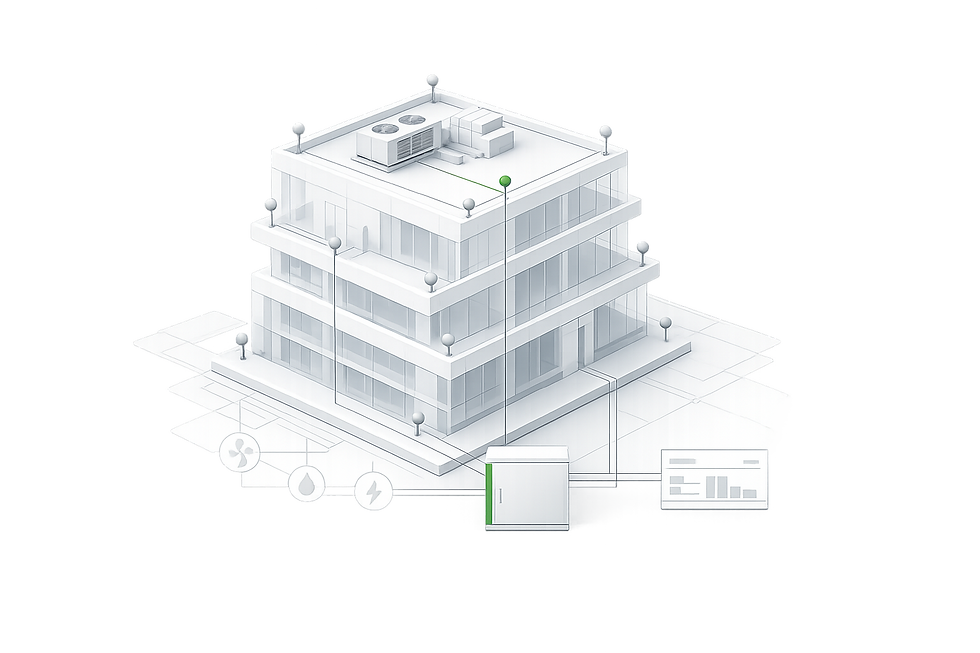
Controls-ready integration that connects building systems, sensors, and equipment into a unified management layer.

Continuous monitoring of air quality and comfort signals to improve health, performance, and operational response.

A twin-ready model connected to live data for visibility, diagnostics, and performance optimization over time.

Secure, permissioned data architecture with auditability to protect systems, users, and lifecycle records.

Automation pathways for inspection, maintenance, and operations—designed to integrate safely with building systems and workflows.

Functional Scope
Primary functions (project-dependent):
• Peak shaving + demand management: discharge during high-load periods to reduce demand peaks and manage electrical capacity constraints; coordinate with BAS/BMS load strategies (HVAC, lighting, EV charging, process loads).
• Renewable smoothing + time shifting: smooth PV/wind variability and shift excess generation to later use; reduce curtailment by absorbing overproduction when storage headroom is available.
• Resilience + ride-through support: provide short-duration ride-through for critical or sensitive operations during disturbances; maintain continuity for prioritized loads under defined scenarios.
• Microgrid support (where designed/permitted): support grid-parallel and islanded operation through defined reserve margins and operating constraints; enable controlled transitions in coordination with the microgrid controller.
• Performance monitoring + asset health: monitor state-of-charge (SOC), power limits, temperature, and fault states; track cycles/throughput for degradation and lifecycle planning.
Integration Interfaces
Typical interface requirements:
• Microgrid + Controls: dispatch setpoints, SOC limits, reserve targets, charge windows, islanding constraints, export limiting, fail-safe behavior.
• Solar Energy + Wind Energy: smoothing logic, ramp-rate constraints, curtailment coordination, charge/discharge prioritization based on generation availability.
• BAS/BMS: status points, alarms, maintenance modes, operator dashboard visibility, demand limiting signals (where implemented).
• Digital Twin + Analytics: storage telemetry ingestion, energy attribution, KPI dashboards, exception reporting, degradation tracking.
• Cybersecurity + Data Governance: segmentation, device identity/access control, logging, patch/firmware governance, secure remote access methods (as applicable).
Controls Logic and Operating Modes
Storage behavior is defined by constraints and measurable targets. Controls typically address:
• Charge scheduling: charge windows aligned with renewable availability and site load conditions.
• Discharge strategy: peak shaving, demand limiting, ride-through support, and reserve protection logic.
• Reserve management: minimum SOC reserve targets for contingency operation; dynamic reserve adjustments by mode.
• Export limiting / grid constraints: enforce interconnection limits and site electrical constraints during grid-parallel operation.
• Islanding behavior (where permitted): coordinated transition logic and operating constraints with the microgrid controller.
• Fault response: safe shutdown, lockout conditions, thermal limits enforcement, and reconnection logic.
Design Inputs (Feasibility and Engineering Constraints)
Storage feasibility and expected performance are driven by measurable inputs:
• Site load profile (interval data where available), peak demand drivers, and operational schedules.
• Critical load definition and resilience targets (which loads, required duration, operating priorities).
• On-site generation profile (PV/wind) and variability characteristics.
• Utility interconnection limits, export constraints, and protection/relaying requirements.
• Space planning + enclosure requirements, ventilation/thermal management intent, maintenance access.
• Safety and compliance constraints (clearances, labeling, emergency shutdown requirements, monitoring and alarms).
• Data/controls integration requirements (telemetry schema, historian logging, dashboards, alarms, retention).
Commissioning and Verification
Energy storage is commissioned as an electrical power subsystem with defined acceptance criteria.
Commissioning scope typically includes:
• Electrical verification (disconnects, grounding, labeling, protection devices, metering).
• Controller configuration verification (SOC limits, power limits, reserve targets, charge/discharge schedules).
• Scenario verification (peak shaving behavior, demand limiting response, ride-through behavior, fail-safe transitions).
• Telemetry validation (time sync, accuracy, historian logging, dashboard correctness).
• Operational stability verification under normal site load variability and defined constraint conditions.
Acceptance criteria examples:
• Verified dispatch response to microgrid/controller commands within defined limits.
• Verified reserve behavior and mode transitions under defined scenarios.
• Validated telemetry completeness, alarm routing, and log retention.
• Verified operation within defined SOC, temperature, and power constraints.
Digital Twin Deliverables
Storage performance is tracked as an auditable subsystem:
• Real-time power (kW) and energy (kWh) with interval data.
• SOC trends, charge/discharge events, and operating mode history.
• Cycle count and throughput metrics for degradation tracking.
• Fault history, alarms, exceptions, and maintenance actions.
• Availability/downtime tracking and operational constraint flags.
Applicable NexGen Prototypes (Storage-Integrated Concepts)
Examples of prototypes where energy storage is incorporated as part of the energy stack:
• Bird Feather
• Sky Lotus
• Cobra
• Double Cobra
• Falcon Eye
• Cloud Machine
• Urban Stream
• NOAH
(Prototype applicability is finalized during feasibility based on siting, interconnection, space planning, and resilience targets.)
Process
Energy Storage in NexGen is implemented as a dispatchable power subsystem with a defined workflow that converts stored energy into stable site operation, coordinated dispatch, and auditable performance data.
The process begins with Use-Case Definition + Sizing, where load profiles, peak drivers, resilience targets, and renewable variability establish the required kW, kWh, reserve margins, and duty cycles. Next, Electrical Architecture + Interconnection defines protection, metering, disconnects, and integration pathways to support safe grid-parallel operation and (where applicable) microgrid transitions.
Controls Integration + Operating Modes then implements charge/discharge logic, demand limiting, renewable smoothing, reserve protection, and fault-handling sequences. Monitoring + Health Management validates SOC estimation, thermal constraints, alarms, and availability tracking. Finally, Digital Twin + KPI Reporting converts verified telemetry into dashboards and histories (kW/kWh, SOC trends, cycles/throughput, availability, exceptions) for lifecycle tracking and continuous optimization.

Case Studies
Energy Storage Across NexGen Prototypes
Wind Power Integration (Operational Use-Cases)
OpDez integrates wind-power systems across the NexGen prototype library as an operationally repeatable pathway—so each concept is designed from day one with defined inspection routes, dispatch and control logic, maintenance and performance validation workflows, and Digital Twin–ready telemetry/event outputs that support real-world operations.
*Proprietary uses not listed

Bird Feather
Energy Storage Use-Cases
• Renewable firming: smooth variability from on-site generation to stabilize building power and reduce ramp events.
• Peak shaving for high-rise spikes: discharge during coincident elevator/HVAC peaks; recharge during predictable low-load windows.
• Export constraint management: absorb surplus generation when export limits, curtailment, or stability constraints occur.
• Resilience reserve logic: protect minimum SOC bands to support prioritized loads and ride-through scenarios.
• Degradation-aware operation: manage cycling/throughput targets to preserve lifecycle performance while meeting demand goals.
• Verification outputs: dispatch setpoints vs response, SOC behavior, exceptions, and alarms logged into the Digital Twin.

Lotus
Energy Storage Use-Cases
• Time shifting: store daytime generation and discharge into evening/night mixed-use demand.
• Demand limiting: cap site peaks created by simultaneous loads (HVAC ramps, amenity loads, vertical transport).
• Power-quality buffering (project-dependent): fast-response support for short disturbances and sensitive load stability.
• Reserve management: maintain protected SOC floors and enforce charge windows to keep resilience capacity available.
• Constraint-aware dispatch: enforce SOC/thermal/power limits while coordinating with microgrid controls and site priorities.
• Lifecycle tracking: cycles/throughput, availability, and fault history recorded for performance validation.

Cobra
Energy Storage Use-Cases
• Peak shaving + load shaping: discharge during short high-demand periods; recharge during scheduled low-demand windows.
• Renewable smoothing: reduce variability impacts on site demand and stabilize power flow under changing conditions.
• Resilience pathway: define priority loads and maintain protected SOC reserves for continuity scenarios.
• Export limiting / curtailment reduction: absorb surplus generation under interconnection constraints.
• Controls + telemetry verification: validate mode transitions, alarm thresholds, and historian logging for auditability.
• Operations readiness: exception reporting (constraint violations, derates, faults) routed into maintenance workflows.

Double Cobra
Energy Storage Use-Cases
• Coincident-peak reduction: manage simultaneous residential + commercial peaks to reduce maximum demand intervals.
• Renewable balancing at tower scale: absorb overproduction and discharge during high-demand periods to increase usable on-site energy.
• Reserve strategy: maintain SOC floors sized to defined contingency scenarios and transition stability requirements.
• Dispatch coordination: align storage behavior with generation variability, export limits, and demand targets across the site.
• Degradation management: control throughput and cycling intensity to balance performance goals with lifecycle preservation.
• Digital Twin verification: log operating modes, setpoints, response, SOC trends, and exceptions for performance review.

Falcon Eye
Energy Storage Use-Cases
• Fast-response stabilization: rapid charge/discharge to reduce ramp impacts from variable generation and dynamic loads.
• Peak shaving at high utilization: reduce top demand intervals while protecting resilience SOC reserves.
• Export/curtailment control: absorb surplus generation to maintain stability under export constraints.
• Microgrid support (where designed/permitted): maintain reserves and support controlled transitions under defined constraints.
• Safety + fault response: enforce derates, lockouts, and protective shutdown logic with clear event logging.
• Audit-ready outputs: SOC, kW/kWh, alarms, and availability histories structured for verification over time.

Cloud Machine
Energy Storage Use-Cases
• Ride-through support: short-duration continuity during disturbances and switching events for prioritized operations.
• Demand smoothing for equipment-driven loads: reduce cyclic/ramping peaks to stabilize site demand profiles.
• Reserve protection: maintain SOC floors and dispatch limits to preserve contingency capacity.
• Constraint-managed dispatch: enforce SOC/thermal/power constraints and classify exceptions (derates, faults, comms loss).
• Commissioning validation: verify dispatch response, telemetry accuracy, and scenario behavior against acceptance criteria.
• Digital Twin continuity: interval data, event logs, and exception flags maintained for diagnostics and KPI reporting.

Urban Stream
Energy Storage Use-Cases
• Demand management for compact office loads: reduce peaks and improve electrical predictability for daily operations.
• Time shifting: store excess generation for late-day demand periods and schedule-driven operation.
• Resilience reserve: maintain protected SOC bands for prioritized continuity scenarios.
• BAS/BMS coordination: align storage modes with HVAC and occupancy schedules to avoid counterproductive cycling.
• Export constraint management: absorb surplus generation when interconnection/export limits apply.
• KPI tracking: SOC, kW/kWh, cycles/throughput, availability, and exceptions logged for lifecycle verification.

NOAH
Energy Storage Use-Cases
• Resource buffering: stabilize intermittent generation and variable loads in a mobile/seaworthy operating profile.
• Reserve + redundancy: maintain SOC reserves for defined contingency scenarios and continuity requirements.
• Conservative dispatch envelopes: enforce thermal/power limits and fault-state behavior under harsh conditions.
• Microgrid continuity (project-dependent): coordinate storage behavior with platform controls for stable autonomous operation.
• Lifecycle evidence: log cycles/throughput, faults, derates, and availability to manage degradation and reliability.
• Operations review outputs: mode history, setpoints, response, and exceptions recorded for auditability and tuning.
