


Nexgen Cyber Security / Data Governance for Buildings
Cybersecurity + Data Governance is the trust layer of NexGen Smart Buildings. It defines how BAS/BMS, microgrid controls, IAQ sensing, metering, Digital Twin services, and (where used) robotics exchange data securely, permissioned, and auditable, so operations teams can rely on performance signals without exposing critical systems.
OpDez does not treat cybersecurity as “IT add-ons.” It is designed as a building subsystem with explicit network zones, identity rules, encryption, logging, retention, and change control, commissioned and handed over like any other system. Where Web3 / tokenization is deployed, governance extends to KPI attestations and oracle inputs so lifecycle records remain verifiable.

Systems Library
NexGen buildings are engineered as integrated systems. Explore the energy, controls, sensing, digital twin, and security modules that can be combined into an energy-independent smart building.

On-site wind generation integrated into the building’s energy system to reduce grid dependence and support resilient operations.

Roof and site photovoltaics paired with controls to deliver clean power and predictable performance.

Battery and storage strategies that smooth peaks, increase resilience, and enable islanding when needed.

A coordinated microgrid architecture that manages generation, storage, loads, and grid interaction in real time.
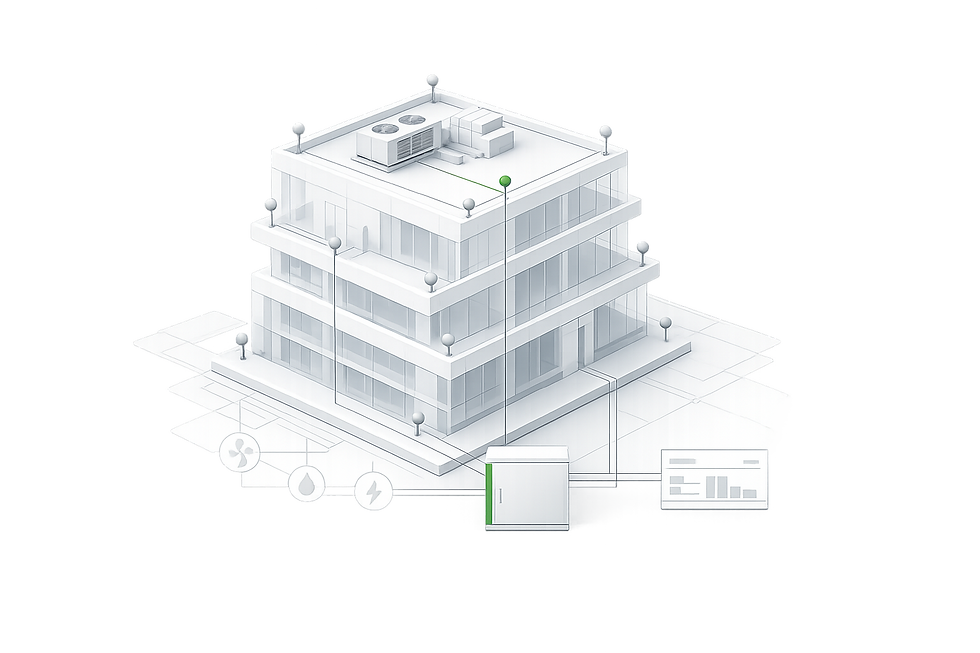
Controls-ready integration that connects building systems, sensors, and equipment into a unified management layer.

Continuous monitoring of air quality and comfort signals to improve health, performance, and operational response.

A twin-ready model connected to live data for visibility, diagnostics, and performance optimization over time.

Secure, permissioned data architecture with auditability to protect systems, users, and lifecycle records.

Automation pathways for inspection, maintenance, and operations—designed to integrate safely with building systems and workflows.

Functional Scope (What Cybersecurity / Data Governance Does)
Primary functions (project-dependent):
-
OT/IT zoning + segmentation
Define network zones (controllers, supervisory, analytics/twin, enterprise) with least-route conduits, DMZ patterns, and explicitly permitted flows. -
Identity + access control (RBAC)
Role-based access for operators, vendors, commissioning teams, and admins with MFA, least privilege, and auditable permissions. -
Secure remote access + vendor governance
Time-boxed access, approvals, session logging, and bounded pathways so support does not create persistent exposure. -
Secure telemetry + integration boundaries
Protected data pipelines from OT to analytics/twin using encryption intent, gateway controls, and write-path constraints. -
Logging + monitoring readiness
Centralized event logs (access, alarms, configuration changes) with retention rules and alerting aligned to operations workflows. -
Lifecycle change control + configuration governance
Baseline hardening, documented configuration states, and controlled updates so systems remain supportable without losing traceability. -
Data governance + auditability (where required)
Data classification, schema rules, retention intent, and lifecycle recordkeeping; optional verification where audit trails matter.
Security Architecture + Governance Layers
Cybersecurity value is defined by measurable boundaries and repeatable governance:
-
Trust zones + conduits
What networks exist, what can communicate, and what is explicitly blocked (especially control write paths into OT). -
Roles + privileges
Who can view, who can change, and what approvals are required for high-impact actions. -
Secure telemetry rules
How data moves (gateways/APIs), what is normalized, and how integrity is maintained end-to-end. -
Data classification + retention
What data is sensitive, where it is stored, who owns it, and how long it is retained. -
Evidence logging
Which events must be logged (access, alarms, config changes), how time sync is enforced, and how evidence is retained. -
Change control
Updates, vendor work, tuning, and system modifications captured as lifecycle events so operational history stays interpretable.
System Interfaces (Required Integration Points)
Cybersecurity / Data Governance is designed to interoperate with NexGen systems through explicit interfaces:
-
BAS/BMS: controller boundaries, supervisory access, point exposure (read/write), alarms, and sequence/change control
-
IAQ + Environmental Sensing: secure edge gateways, thresholds, calibration/validation markers, and event logging
-
Microgrid + Controls: EMS boundary definition, mode/state logs, and protected dispatch/control write paths
-
Energy systems (wind/solar/storage): inverter/PCS boundaries, metering ingestion, constraints, and exception logging
-
Digital Twin + Analytics: API gateway boundaries, schema governance, retention rules, and audit histories for KPIs/exceptions
-
Robotics (where used): isolated networks, controlled updates, evidence-package integrity (time/location stamps + structured logs)
Design Inputs (Security Feasibility + Data Constraints)
Cybersecurity feasibility and governance quality are driven by measurable inputs:
-
Asset inventory + criticality
What systems exist (OT/IT), what is mission-critical, and what constitutes unacceptable downtime or compromise. -
Vendor ecosystem + protocols
Controller/vendor landscape, protocol constraints, and support requirements that shape segmentation and access design. -
Telemetry + control exposure
What is readable vs writable, trend frequency, alarm/event access, and required operator workflows. -
Remote access + support model
Who needs access, when, from where, and what approvals/logging are required. -
Risk posture + acceptance requirements
Owner constraints, operational tolerance, and audit expectations that shape controls, logging, and retention. -
Data classification + retention intent
How long data is kept, where it lives, who owns it, and how schema/version changes are governed over time.
These inputs are established during Discovery + Threat Modeling and become the basis for zoning, identity rules, telemetry handling, logging, and commissioning acceptance.
Commissioning and Verification
Cybersecurity / Data Governance is commissioned as an operational subsystem with defined acceptance criteria.
Commissioning scope typically includes:
-
Segmentation verification
Zones, conduits, firewall rules, DMZ boundaries, and permitted flows validated against the design intent. -
Identity + access verification
RBAC correctness, MFA enforcement, least privilege, and privileged workflows validated with audit logs. -
Remote access workflow verification
Time-boxed vendor access, approvals, session logging, and bounded pathways verified in real scenarios. -
Logging + retention verification
Event completeness, time sync integrity, retention policy enforcement, and alert routing validated. -
Data governance verification
Schema/naming/units intent (as applicable), ownership rules, and lifecycle change tracking verified for defined KPI scope.
Acceptance criteria examples:
-
Verified OT/IT zoning with documented permitted flows and blocked write paths (as required).
-
Verified RBAC + MFA with auditable access logs and vendor-control workflow.
-
Verified logging completeness and retention for defined scope (alarms, access, configuration changes).
-
Verified secure telemetry boundaries feeding analytics/twin without exposing OT control surfaces.
-
Confirmed lifecycle logs capture changes so performance history remains interpretable over time.
Cybersecurity / Data Governance Deliverables
Cybersecurity / Data Governance produces consistent, operations-ready outputs:
-
Network zoning + allowed-flow map
Zones/conduits/DMZ intent with permitted data flows and protected boundaries. -
Access control matrix
Roles, privileges, MFA requirements, and approval workflows (including vendor access). -
Secure telemetry + integration boundary spec
Gateway/API boundaries, encryption intent, and rules for read/write separation. -
Data governance specification
Data classification, ownership, retention intent, and schema/version governance rules (as applicable). -
Logging + monitoring package
What is logged, where it is retained, alert thresholds, and escalation routing aligned to operations. -
Commissioning + acceptance test plan
Verification scenarios and acceptance criteria for segmentation, access, telemetry boundaries, and logging.
Process
Cybersecurity / Data Governance in NexGen is implemented as a repeatable workflow that protects OT systems while preserving the integrity of operational data.
The process begins with Discovery + Threat Modeling, where critical assets, OT/IT boundaries, and read/write permissions are defined across BAS/BMS, microgrid controls, sensing, and Digital Twin services. Next, Zone Architecture + Identity Design establishes segmentation, gateways/DMZ boundaries, and role-based access aligned to real operational responsibilities and vendor support needs.
Then Secure Telemetry + Governance Rules define how signals move safely from OT to analytics/twin, how data is classified and retained, and how evidence (events, alarms, changes) is logged. Finally, Commissioning + Verification tests segmentation, access, logging, and governance controls against acceptance criteria and produces handover-ready artifacts for lifecycle operations.

Case Studies
Robotics Integration Across NexGen Prototypes
(Operational Use-Cases)
OpDez integrates Cybersecurity / Data Governance across the NexGen prototype library as an operationally repeatable pathway, so each concept is designed from day one with defined security zones, permissioned access, protected telemetry boundaries, and audit-ready logs that support real-world operations.
Cybersecurity / Data Governance is treated as the trust layer for NexGen performance: it protects critical systems, preserves data integrity, and maintains durable lifecycle records so improvements can be made without losing traceability.

Bird Feather
Cybersecurity / Data Governance Use-Cases
-
Segmentation: isolate OT controls from enterprise/twin networks with explicit permitted flows.
-
Protected write paths: constrain control changes to authorized roles and approved workflows.
-
Audit trail: log alarms, mode changes, and configuration updates for lifecycle traceability.
-
Secure telemetry: encrypted, governed feeds into the twin for KPI histories and exception review.
-
Vendor governance: time-boxed remote access with session logging for support/commissioning.

Sky Lotus
Cybersecurity / Data Governance Use-Cases
-
Role-based access: structured privileges for operators, vendors, and stakeholders across multi-zone operations.
-
Secure sensor + metering ingestion: analytics visibility without exposing controller networks.
-
Evidence logging: alarms, access events, and configuration changes retained for audit-ready histories.
-
Governance rules: data ownership + retention intent so benchmarking remains defensible over time.

Cobra
Cybersecurity / Data Governance Use-Cases
-
Secure integration boundary: BAS/BMS + IAQ + energy telemetry routed through governed interfaces.
-
Vendor remote access workflow: approvals + time-boxed sessions + session logging.
-
Change control: tuning and sequence adjustments captured with who/what/when evidence.
-
Operational logging: exceptions → corrective actions documented with traceable outcomes.

Double Cobra
Cybersecurity / Data Governance Use-Cases
-
Consistent zoning + identity rules across paired structures to enable safe comparative operations.
-
Cross-structure evidence: synchronized event logs for shared modes, constraints, and exceptions.
-
Controlled change management: tuning in one structure remains traceable and comparable to the other.
-
Governance continuity: aligned retention and access rules so lifecycle records stay consistent.

Falcon Eye
Cybersecurity / Data Governance Use-Cases
-
High-integrity segmentation and least-privilege access for mission-critical operations (scope-dependent).
-
Alarm integrity + logging: verify routing, categorization, and response documentation with retention.
-
Incident readiness: evidence capture aligned to operational roles and escalation pathways.
-
Configuration governance: validated baselines and controlled updates for critical systems (scope-dependent).

Cloud Machine
Cybersecurity / Data Governance Use-Cases
-
Lifecycle governance intent: define secure update pathways early for long-lived systems.
-
Secure data boundaries: controlled telemetry flows that support commissioning continuity and future analytics.
-
Audit trail for exceptions: flag → classify → correct → verify outcome with retained evidence.
-
Data retention readiness: time sync, logging completeness, and retention intent validated.

Urban Stream
Cybersecurity / Data Governance Use-Cases
-
Right-sized segmentation: preserve OT/IT boundaries for compact systems stacks.
-
Permissioned dashboards: stakeholder visibility with explicit access and retention rules.
-
Vendor support without exposure: time-boxed access + logging for maintenance workflows.
-
Simple lifecycle records: tuning and maintenance verification captured for ongoing operations.

NOAH
Cybersecurity / Data Governance Use-Cases
-
Resilience event governance: log operational modes, constraints, and exceptions for post-event review.
-
Protected write-path controls: ensure critical sequences are constrained to authorized workflows.
-
Evidence-based outcomes: document “before/after” tuning and repairs with retained logs and measured results.
-
Secure integration: unify sensing + controls + analytics with governed boundaries and retention intent.
