


Nexgen BMS / BAS
Robotics in NexGen Smart Buildings is treated as an operations subsystem that executes repeatable tasks and converts physical conditions into auditable, structured data for the BAS/BMS and Digital Twin. The scope is not “robot procurement.” It is the integration architecture—interfaces, workflows, safety constraints, cybersecurity posture, and commissioning criteria—required for reliable automation in occupied or mission-critical environments.
Systems Library
NexGen buildings are engineered as integrated systems. Explore the energy, controls, sensing, digital twin, and security modules that can be combined into an energy-independent smart building.

On-site wind generation integrated into the building’s energy system to reduce grid dependence and support resilient operations.

Roof and site photovoltaics paired with controls to deliver clean power and predictable performance.

Battery and storage strategies that smooth peaks, increase resilience, and enable islanding when needed.

A coordinated microgrid architecture that manages generation, storage, loads, and grid interaction in real time.
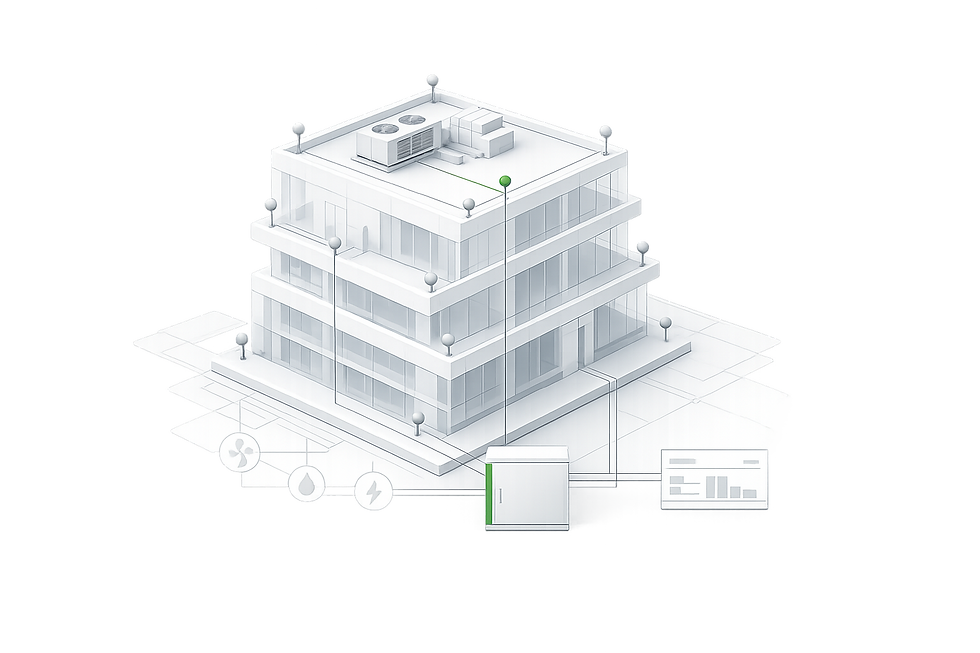
Controls-ready integration that connects building systems, sensors, and equipment into a unified management layer.

Continuous monitoring of air quality and comfort signals to improve health, performance, and operational response.

A twin-ready model connected to live data for visibility, diagnostics, and performance optimization over time.

Secure, permissioned data architecture with auditability to protect systems, users, and lifecycle records.

Automation pathways for inspection, maintenance, and operations—designed to integrate safely with building systems and workflows.

Functional Scope (What Robotics Does)
Robotics functions are implemented in five technical classes (project-dependent):
1) Autonomous Inspection + Condition Monitoring
-
Scheduled interior/exterior routes, envelope checks, roof scans, and equipment space verification
-
Evidence packages: timestamped imagery/thermal/video + location + event tags + severity
2) Sensor-Triggered Dispatch
-
Event response based on IAQ thresholds, leak detection, vibration/noise anomalies, access alarms
-
Confirmation workflow (verify → classify → notify → log)
3) Operations Support
-
Routine monitoring of critical rooms, asset state verification, and exception reporting
-
Structured handoff to maintenance tickets (punchlist / work orders)
4) Maintenance Enablement
-
Repeatable baseline capture for trending (seasonal comparisons, degradation tracking)
-
“Before/after” validation following repairs, tuning, or commissioning adjustments
5) Security Augmentation (Non-enforcement)
-
Observation, remote presence, and incident documentation
-
Strict boundaries: no life-safety override; robotics respects egress and emergency sequences
System Interfaces (Required Integration Points)
Robotics is designed to interoperate with NexGen systems through explicit interfaces:
-
BAS/BMS: schedules, modes, safety interlocks, occupancy constraints
-
IAQ + Environmental Sensing: triggers, thresholds, alarms, local validation
-
Microgrid + Controls: charging windows, load-shed modes, islanding constraints
-
Digital Twin + Analytics: asset mapping, telemetry schema, event logs, KPI dashboards
-
Cybersecurity + Data Governance: network segmentation, identity/access management, patching/firmware lifecycle, logging
Commissioning + Acceptance (Technical Validation)
Robotics is commissioned like any building subsystem:
-
Interface tests (BMS points, sensor triggers, network connectivity, time sync)
-
Scenario tests (alarm-dispatch, route-block handling, safe stop, return-to-dock)
-
Data validation (event completeness, location accuracy, log retention)
-
Acceptance metrics (route completion rate, response latency, fault rates, uptime)
Process
Robotics + Automation in NexGen is implemented as an operations subsystem with a defined functional workflow that turns on-site activity into measurable, auditable performance.
The process begins with Autonomous Inspection + Condition Monitoring, where robotics executes repeatable routes (interior/exterior), captures thermal/visual evidence, and tags observations with time, location, and severity. When conditions exceed defined thresholds, Sensor-Triggered Dispatch initiates event response workflows using IAQ, leak, vibration/noise, or access signals to verify anomalies, classify impact, and generate structured logs. These outputs feed Operations Support, where exceptions are converted into actionable items, asset state verification, task completion reporting, and maintenance/work-order triggers. In Maintenance Enablement, baseline datasets are compared over time to support trending, degradation tracking, and before/after validation following repairs or control tuning. Finally, Security Augmentation (Non-enforcement) provides observation and documentation functions with a complete audit trail, operating under strict safety constraints and without overriding life-safety systems.
Across all stages, the system produces consistent outputs: Digital Twin telemetry, BAS/BMS events, KPI updates, and compliance-ready logs.

Case Studies
BAS / BMS Integration Across NexGen Prototypes
(Operational Use-Cases)
OpDez models robotics as a repeatable operations pathway across the NexGen prototype library—so each concept can be designed with inspection routes, dispatch logic, maintenance validation, and Digital Twin-ready event outputs from day one.
*Proprietary uses not listed

Bird Feather
Robotics Use-Cases
-
Autonomous inspection: wind system exterior checks, roof scans, envelope condition monitoring.
-
Sensor-triggered dispatch: investigate IAQ/leak anomalies; verify and log with evidence packages.
-
Maintenance enablement: seasonal baselines + “before/after” validation after tuning/repairs.

Sky Lotus
Robotics Use-Cases
-
Autonomous inspection: vertical/exterior routes + intake/outlet condition checks (where applicable).
-
Operations support: routine monitoring of critical rooms; exception reporting into work orders.

Cobra
Robotics Use-Cases
-
Operations pathway intent: robotics + automation are treated as part of NexGen technology integration for future smart cities, including robotics-enabled operations.
-
Autonomous inspection: façade/envelope verification, roof scans, equipment-room verification.
-
Dispatch + logging: IAQ/leak/vibration/access-triggered verification → structured logs.

Double Cobra
Robotics Use-Cases
-
Autonomous inspection: paired-structure exterior routes + roof/equipment-space verification.
-
Maintenance enablement: degradation tracking via repeatable baselines and validation logs.

Falcon Eye
Robotics Use-Cases
-
Security augmentation (non-enforcement): observation + incident documentation with audit trail.
-
Operations support: asset state verification + exception reporting into maintenance workflows.

Cloud Machine
Robotics Use-Cases
-
Autonomous inspection: exterior + roof scans; equipment-space verification; evidence capture.
-
Commissioning validation: scenario tests (route-block handling, safe stop, return-to-dock) + acceptance metrics

Urban Stream
Robotics Use-Cases
-
Operations support: routine monitoring, exception reporting, and structured handoff into work orders.
-
Digital twin outputs: telemetry + event logs + KPI updates designed to be consistent and auditable.

NOAH
Robotics Use-Cases
-
Sensor-triggered dispatch: respond to IAQ/leak/access events with verify → classify → notify → log workflow.
-
Maintenance enablement: before/after verification following repairs and commissioning adjustments.
