


Nexgen IAQ + Environmental Sensing for Buildings
IAQ + Environmental Sensing is the measurement and response layer that makes NexGen buildings healthy, stable, and verifiable. It combines indoor air quality sensing (CO₂, particulates, VOC indicators, and related signals) with environmental sensing (temperature, humidity, pressure/airflow conditions, and comfort proxies) so ventilation and filtration behavior can be explicitly defined, commissioned, and continuously validated over time.
The objective is not “a sensor list.” It is a measurable sensing architecture with clear thresholds, response tiers, and logging requirements that integrate directly into BAS/BMS sequences and Digital Twin dashboards. IAQ + Environmental Sensing integrates with BAS/BMS, Microgrid + Controls, Digital Twin + Analytics, and Cybersecurity + Data Governance so health/comfort outcomes remain stable during normal operation, peak demand, or constrained energy modes, without losing traceability after turnover.
Systems Library
NexGen buildings are engineered as integrated systems. Explore the energy, controls, sensing, digital twin, and security modules that can be combined into an energy-independent smart building.

On-site wind generation integrated into the building’s energy system to reduce grid dependence and support resilient operations.

Roof and site photovoltaics paired with controls to deliver clean power and predictable performance.

Battery and storage strategies that smooth peaks, increase resilience, and enable islanding when needed.

A coordinated microgrid architecture that manages generation, storage, loads, and grid interaction in real time.
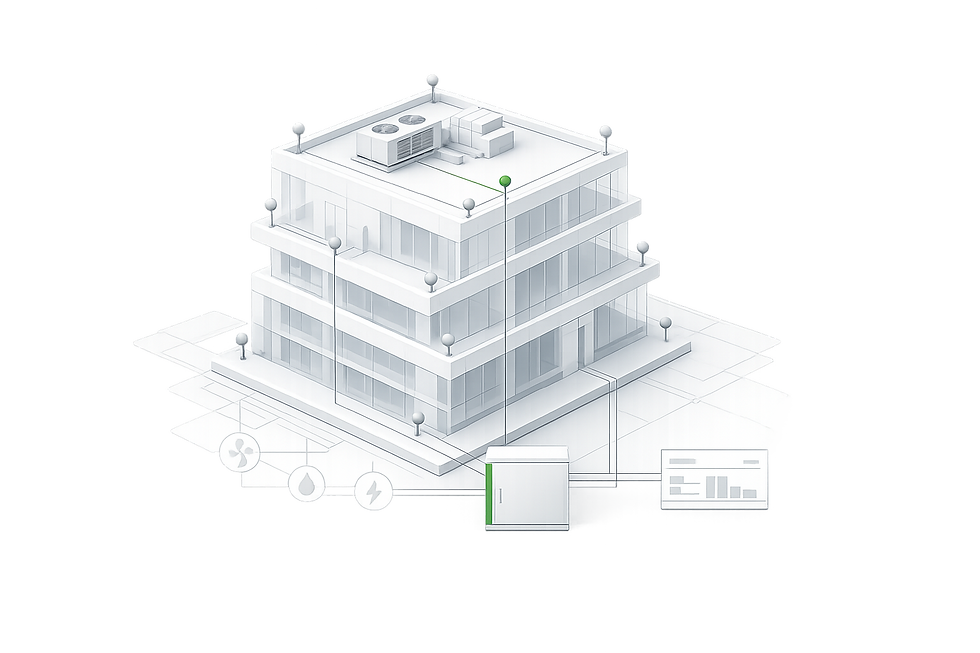
Controls-ready integration that connects building systems, sensors, and equipment into a unified management layer.

Continuous monitoring of air quality and comfort signals to improve health, performance, and operational response.

A twin-ready model connected to live data for visibility, diagnostics, and performance optimization over time.

Secure, permissioned data architecture with auditability to protect systems, users, and lifecycle records.

Automation pathways for inspection, maintenance, and operations—designed to integrate safely with building systems and workflows.

Functional Scope (What IAQ + Environmental Sensing Does)
Primary functions (project-dependent):
-
Air quality measurement + trending
Continuous measurement of IAQ indicators (project-defined) with time-synced trends and retention rules to support verification and troubleshooting. -
Environmental condition sensing
Temperature, RH, dewpoint risk indicators, and space/zone conditions used to protect comfort stability and reduce moisture-related failure modes. -
Ventilation performance visibility
Signals that support “is ventilation doing what we think it’s doing?”—including zone-level IAQ response evidence and ventilation mode status (as integrated). -
Thresholds + response tiers
Defined trigger thresholds, escalation tiers, hold-off rules, and return-to-normal criteria so responses are predictable—not ad hoc. -
BAS/BMS integration for ventilation + filtration control
Demand-driven ventilation actions, purge logic, filtration mode shifts, and equipment responses executed through explicit BAS/BMS sequences (project-defined). -
Alarm + exception governance
Actionable alarms and exception flags (not noise): severity tiers, routing intent, and event categorization for operator usability. -
Measurement + verification readiness
Point naming, calibration intent (where applicable), time sync requirements, historian requirements, and KPI definitions aligned with commissioning acceptance criteria.
Sensing Logic and Response Modes
IAQ behavior is defined by thresholds, response tiers, and measurable targets. Sensing + response logic typically addresses:
-
Target definition
Which IAQ/environmental indicators matter for the program (office, residential, lab, mission-critical), and what “in spec” means (project-defined). -
Zone strategy + sensor placement intent
Where sensing is required (high-occupancy zones, critical rooms, return paths, shafts, entry/transition zones) so the system is representative—not blind. -
Response tier design
Normal → elevated → mitigation/purge behaviors with defined triggers, actions, maximum limits, and recovery criteria. -
Outdoor air quality gating (as applicable)
Rules that prevent “ventilating with bad air” when outdoor conditions are degraded (project-defined), including mode shifts and lockouts. -
Energy-aware ventilation behavior
Coordination with Microgrid + Controls and demand modes so IAQ minimums and comfort stability are preserved under constrained energy operation (project-defined). -
Degraded-mode behavior
Defined fallback logic under sensor loss, comms loss, or device faults (fail operational vs fail safe—project-defined), with clear exceptions logged.
Design Inputs (Feasibility and Engineering Constraints)
IAQ feasibility and performance are driven by measurable inputs:
-
Program + occupancy patterns
Density, schedules, high-risk spaces, and the operational intent of the building. -
HVAC/ventilation system architecture
DOAS/VAV/VRF/central plant intent, exhaust/makeup strategy, and controllability constraints. -
Filtration + air cleaning intent (project-defined)
Filter class strategy, pressure drop considerations, maintenance access, and any supplemental treatment approaches. -
Envelope + pressure relationships
Infiltration/exfiltration risk, stack effect considerations, and pressure control requirements for critical spaces (project-defined). -
Sensor quality + calibration expectations
Accuracy class intent, drift risk, replacement strategy, and validation/spot-check requirements (project-defined). -
Communications + cybersecurity constraints
Network segmentation, identity/access control boundaries, time sync requirements, logging requirements, and data retention/ownership intent.
These inputs are established during Discovery + Feasibility and form the basis for response tiers, BAS/BMS sequences, commissioning scenarios, and acceptance criteria.
Commissioning and Verification
IAQ + Environmental Sensing is commissioned as an integrated sensing + controls subsystem with defined acceptance criteria.
Commissioning scope typically includes:
-
Sensor verification
Installation verification, calibration checks (as applicable), signal plausibility checks, and time sync verification. -
Trend integrity verification
Sampling rules, retention rules, historian capture, and dashboard correctness. -
Response sequence verification
Trigger → action → stabilization → recovery testing for defined response tiers (ventilation escalation, purge, filtration modes, and return-to-normal behavior). -
Alarm + exception verification
Alarm routing, severity tiers, hold-off rules, nuisance reduction intent, and recovery criteria. -
KPI validation
KPI math validation, exception flag logic, and baseline capture for seasonal comparison.
Acceptance criteria examples:
-
Verified sensing coverage and signal stability in representative zones (project-defined).
-
Verified IAQ response tiers with documented triggers, actions, and recovery criteria.
-
Verified comfort stability behaviors (temperature/RH/condensation-risk proxies) within defined limits (project-defined).
-
Validated trend completeness, time sync, alarm routing, and operator usability.
-
Verified degraded-mode behavior under defined failure scenarios (sensor loss, comms loss, device fault).
Digital Twin Deliverables
IAQ + Environmental Sensing is tracked as an auditable subsystem:
-
Real-time IAQ + comfort dashboards
Zone-level IAQ indicators (project-defined), temperature/RH trends, and status of ventilation/filtration modes. -
Event history (threshold exceedance + response actions)
Timestamped exceedances, response tier activations, purge events, and recovery events. -
Alarm + exception histories
Alarms, comms loss events, sensor faults, out-of-range flags, and categorized exceptions. -
Maintenance-driving indicators (as integrated)
Filter loading proxies/pressure indicators, abnormal drift flags, and “needs attention” exceptions. -
KPI dashboards
Percent time in spec (project-defined), exceedance frequency/duration by zone, response latency, and seasonal baseline comparison indicators.
Process
IAQ + Environmental Sensing in NexGen is implemented as a coordinated sensing + controls workflow that turns occupant health and comfort intent into measurable, testable building behavior. The process begins with Performance Targets + Sensing Strategy Definition, where IAQ indicators, comfort stability intent, critical zones, and response tiers are defined and translated into a sensing map and point requirements.
Next, BAS/BMS Response Sequencing establishes explicit trigger thresholds, ventilation/filtration actions, purge logic, and recovery criteria, including degraded-mode behavior under sensor or comms loss. In Commissioning Scenarios + Verification, the system is tested against defined scenarios (trigger accuracy, response behavior, stabilization, recovery, alarm routing, logging completeness) and acceptance criteria. Finally, Digital Twin + KPI Reporting converts verified telemetry and event logs into dashboards and histories so IAQ performance can be audited over time and tuned without destroying traceability.
Across all stages, the system produces consistent outputs: sensing maps, point lists, threshold definitions, response tier logic, alarm matrices, trend requirements, KPI definitions, and compliance-ready logs.

Case Studies
IAQ + Environmental Sensing Across NexGen Prototypes
(Operational Use-Cases)
OpDez integrates IAQ + Environmental Sensing across the NexGen prototype library as an operationally repeatable pathway, so each concept is designed from day one with defined sensing coverage, response tiers, BAS/BMS integration logic, and Digital Twin–ready telemetry/event outputs that support real-world operations. IAQ + Environmental Sensing is treated as the “health + comfort truth layer” of the building: it measures what matters, triggers predictable responses, and preserves auditable records so outcomes can be commissioned, validated, and continuously verified.
*Proprietary uses not listed

Bird Feather
IAQ + Environmental Sensing Use-Cases
-
High-rise zoning strategy: representative sensing across stacked zones and shared amenity areas (project-defined).
-
Demand-driven ventilation: CO₂/IAQ-triggered ventilation escalation with defined recovery behavior and logging.
-
Humidity/comfort stability: temperature/RH stability indicators and exception flags for drift or risk conditions.

Sky Lotus
IAQ + Environmental Sensing Use-Cases
-
Variable occupancy sensing: IAQ signals tuned to real use patterns to reduce wasted ventilation runtime while preserving targets.
-
Outdoor air gating: mode shifts when outdoor conditions are poor (project-defined), with traceable event logs.
-
Baseline comparison: seasonal baselines + exception flags designed for continuous verification.

Cobra
IAQ + Environmental Sensing Use-Cases
-
Distributed sensing coverage: consistent IAQ mapping and response logic across paired structures (project-defined).
-
Pressure/airflow intent (as applicable): monitored differentials and exception logging to protect zoning assumptions.
-
Continuous verification: time-synced trends and response event logs maintained for lifecycle traceability.

Double Cobra
IAQ + Environmental Sensing Use-Cases
-
High-reliability IAQ monitoring: conservative thresholds and response logic aligned with continuity intent (project-defined).
-
Exception governance: structured alarms and categorized exceptions to support operations under demanding conditions.
-
Cybersecurity-aligned telemetry: logging and governance intent maintained for lifecycle operation.

Falcon Eye
IAQ + Environmental Sensing Use-Cases
-
Equipment-driven environment monitoring: sensing tuned for equipment-heavy environments and cyclic/ramping conditions (project-defined).
-
Response sequencing: defined ventilation/filtration actions with stabilization and recovery criteria.
-
Commissioning validation: verify sensing integrity, alarm routing, and response-tier behavior against acceptance criteria.

Cloud Machine
IAQ + Environmental Sensing Use-Cases
-
Equipment-driven environment monitoring: sensing tuned for equipment-heavy environments and cyclic/ramping conditions (project-defined).
-
Response sequencing: defined ventilation/filtration actions with stabilization and recovery criteria.
-
Commissioning validation: verify sensing integrity, alarm routing, and response-tier behavior against acceptance criteria.

Urban Stream
IAQ + Environmental Sensing Use-Cases
-
Office-centric comfort + IAQ stability: predictable workday behavior with after-hours exception handling and logging.
-
Energy-aware ventilation: IAQ minimums preserved while coordinating with demand modes (project-dependent).
-
KPI reporting: trend completeness and exception flags maintained for tuning and lifecycle tracking.

NOAH
IAQ + Environmental Sensing Use-Cases
-
Resilience-first sensing strategy: conservative sensing coverage and response logic aligned with continuity and stability intent (project-defined).
-
Priority-space governance: explicit IAQ/comfort rules for critical rooms and essential spaces with clear override hierarchy.
-
Evidence-based operations: exceedance histories, response events, and KPI outputs retained for verification over time.
