


NexGen Microgrid + Controls for Buildings
The Microgrid + Controls module is the orchestration layer of the NexGen energy stack. It coordinates on-site generation (wind/solar), energy storage, critical loads, and grid interaction through defined operating modes, protection logic, and real-time dispatch. The objective is not “controls in general.” It is an islanding-ready microgrid architecture with explicit sequences, constraints, and measurable performance outputs that can be commissioned, validated, and monitored over time.
Microgrid + Controls integrates directly with Wind Energy, Solar Energy, Energy Storage, BAS/BMS, Digital Twin + Analytics, and Cybersecurity + Data Governance. This integration enables load prioritization, export limiting, fault handling, KPI reporting, and lifecycle records that remain auditable and operationally useful after turnover.
Systems Library
NexGen buildings are engineered as integrated systems. Explore the energy, controls, sensing, digital twin, and security modules that can be combined into an energy-independent smart building.

On-site wind generation integrated into the building’s energy system to reduce grid dependence and support resilient operations.

Roof and site photovoltaics paired with controls to deliver clean power and predictable performance.

Battery and storage strategies that smooth peaks, increase resilience, and enable islanding when needed.

A coordinated microgrid architecture that manages generation, storage, loads, and grid interaction in real time.
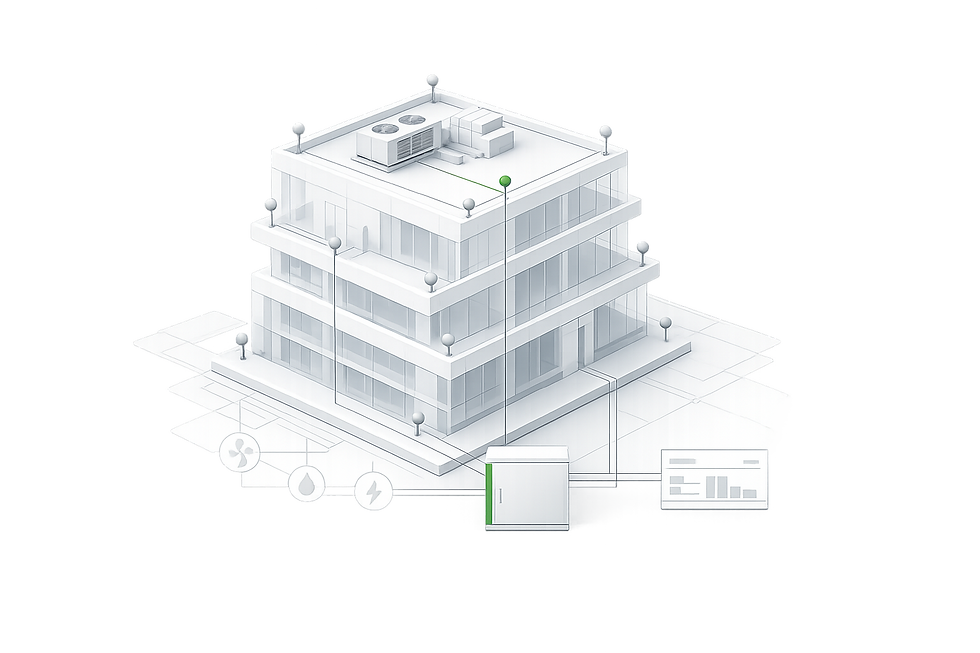
Controls-ready integration that connects building systems, sensors, and equipment into a unified management layer.

Continuous monitoring of air quality and comfort signals to improve health, performance, and operational response.

A twin-ready model connected to live data for visibility, diagnostics, and performance optimization over time.

Secure, permissioned data architecture with auditability to protect systems, users, and lifecycle records.

Automation pathways for inspection, maintenance, and operations—designed to integrate safely with building systems and workflows.

Functional Scope (What Microgrid+Controls Does)
Primary functions (project-dependent):
-
Operating mode management
Grid-parallel operation, island-ready operation, and controlled transitions (where permitted) with defined stability constraints. -
Dispatch + coordination
Real-time setpoints for storage charge/discharge, renewable curtailment, and controllable loads based on site priorities, constraints, and limits. -
Load prioritization + shedding
Tiered load groups (critical / essential / discretionary) with explicit shed and restore sequences. -
Interconnection + export limiting
Enforce utility constraints, site electrical limits, and contractual/export boundaries through control logic and metering at the PCC. -
Power quality + stability support (as applicable)
Voltage/frequency support behaviors, ramp management, and coordinated responses aligned with the electrical design intent. -
Event handling + fail-safe behavior
Alarms, comms-loss behavior, lockouts, safe states, and recovery sequences defined as testable scenarios. -
Measurement + verification readiness
Time-synced telemetry, clear point naming, historian requirements, and KPI definitions to support commissioning and ongoing validation.
Controls Logic and Operating Modes
Microgrid behavior is defined by constraints and measurable targets. Controls typically address:
-
Priority definition
What stays powered first, what sheds first, and what restarts automatically versus manually. -
Islanding logic (where permitted)
Island entry conditions, transition sequencing, stability criteria, and resynchronization/reconnect logic. -
Dispatch constraints
SOC reserve protection, maximum demand limits, export limits, and curtailment rules during saturation or stability events. -
Restore logic
Staged load restoration to avoid inrush peaks and instability after switching events or outages. -
Fault response + protective coordination (design-dependent)
Protective actions, lockouts, safe-state behavior, alarm routing, and recovery criteria. -
Degraded-mode behavior
Defined response under partial telemetry loss, controller loss, or device loss (fail operational vs fail safe—project-defined).
Design Inputs (Feasibility and Engineering Constraints)
Microgrid feasibility and performance are driven by measurable inputs:
-
Load profile + peak demand
Daily/seasonal demand shape, critical-load definition, and runtime intent.
-
DER inventory + constraints
PV/wind capacities, storage kW/kWh, inverter limits, and any standby generation intent (if applicable).
-
Electrical topology
One-line design intent, switchgear lineup concept, PCC location, feeder strategy, and space/clearance constraints.
-
Protection + coordination basis
Short-circuit assumptions, coordination approach, transfer scheme, and islanding permissibility.
-
Utility interconnection limits
Export rules, metering requirements, relay requirements, and operational constraints from the serving utility.
-
Communications architecture
Controller-to-device integration, network segmentation, time sync requirements, and historian/data retention intent.
These inputs are established during Discovery + Feasibility and form the basis for control sequences, operating envelopes, and commissioning acceptance criteria.
Commissioning and Verification
Microgrid + Controls is commissioned as a coordinated electrical subsystem with defined acceptance criteria.
Commissioning scope typically includes:
-
Control point verification
Status, commands, alarms, setpoints, time sync, historian capture, and dashboard correctness. -
Mode verification
Grid-parallel constraints, island-ready logic, and transition sequences (where allowed). -
Scenario verification
Load-shed, curtailment, export limiting, SOC reserve protection, and restore sequencing. -
Fail-safe verification
Comms loss behavior, controller loss behavior, device fault responses, lockouts, and recovery criteria. -
KPI validation
Meter accuracy checks (as applicable), KPI math validation, and exception flagging logic.
Acceptance criteria examples:
-
Verified load-priority behavior and shed/restore sequencing.
-
Verified export limiting and constraint enforcement.
-
Verified stable mode behaviors and recovery behavior (where permitted).
-
Validated telemetry completeness, time sync, and alarm routing.
-
Verified scenario responses within defined limits (latency, stability outcomes, logging completeness).
Digital Twin Deliverables
Microgrid operation is tracked as an auditable subsystem:
-
Real-time power flows (kW) and interval energy (kWh)
At the PCC and key distribution points. -
Mode history
Grid-parallel / island-ready / islanded (where permitted), including timestamps and transitions. -
Dispatch histories
Storage setpoints, curtailment events, load-shed events, and restore events. -
Alarm + fault histories
Protective events, lockouts, comms loss, device faults, and categorized exceptions. -
KPI dashboards
Peak-demand reduction, export compliance, autonomy runtime (where applicable), uptime/availability, and exception flags.
Process
Microgrid + Controls in NexGen is implemented as a coordinated electrical + controls workflow that turns distributed energy assets into stable, controllable power with verifiable operating records.
The process begins with Site Electrical Architecture + Constraints Definition, where load priorities, runtime intent, export limits, and operating modes are defined and translated into a one-line concept, PCC strategy, and protection intent. Next, DER + Device Integration Mapping establishes the control boundaries between inverters, storage, meters, protective devices, BAS/BMS load controls, and the microgrid controller/EMS.
Controls Sequences + Operating Modes then define dispatch rules (SOC reserve protection, charge windows, curtailment thresholds, load-shed/restoration logic), islanding/transition behavior (where permitted), and fail-safe responses under comms loss or device faults. In Commissioning Scenarios + Verification, the system is tested against defined scenarios (constraint enforcement, disturbances, transitions, recovery, logging completeness) and acceptance criteria.
Finally, Digital Twin + KPI Reporting converts verified telemetry and event logs into dashboards and histories (PCC kW/kWh, mode states, dispatch events, alarms, exceptions) so performance can be audited over time and tuned without losing traceability.
Across all stages, the system produces consistent outputs: microgrid mode states, dispatch setpoints, BAS/BMS signals, alarm/fault events (as integrated), KPI dashboard updates, and compliance-ready logs.

Case Studies
Micorgrid+Controls Integration Across NexGen Prototypes
(Operational Use-Cases)
OpDez integrates microgrid controls across the NexGen prototype library as an operationally repeatable pathway—so each concept is designed from day one with defined load priorities, export constraints, dispatch logic, mode behavior, and Digital Twin–ready telemetry/event outputs that support real-world operations.
Microgrid + Controls is treated as the “truth layer” for electrical operation: it sequences how generation and storage interact with loads, how constraints are enforced, and how the building behaves during grid events. The result is commissioning-ready control logic with measurable outcomes and auditable lifecycle records.
*Proprietary uses not listed

Bird Feather
Microgrid+Controls Use-Cases
-
Mode strategy: grid-parallel constraints with island-ready logic for defined critical-load continuity (project-dependent).
-
Load prioritization: tiered load groups (vertical transport, life-safety, core MEP, tenant loads) with explicit shed/restore sequences.
-
Export limiting + curtailment: enforce interconnection constraints and stability rules during high generation or low load conditions.
-
Storage coordination: SOC reserve protection and dispatch rules aligned with peak periods and contingency intent.
-
Fault handling: comms-loss and device-fault behavior defined as testable scenarios with clear alarm routing.
-
Verification outputs: PCC kW/kWh, mode history, dispatch events, and exceptions logged into the Digital Twin.

Lotus
Microgrid+Controls Use-Cases
-
Variable generation coordination: dispatch rules that stabilize fluctuating renewable output through storage and controllable loads.
-
Operating envelope definition: ramp constraints, curtailment thresholds, and power-quality constraints aligned with site needs.
-
Demand limiting: cap peaks created by coincident loads through prioritized dispatch and BAS/BMS coordination.
-
Transition readiness (project-dependent): defined behaviors for disturbances, recovery, and controlled transitions where allowed.
-
Telemetry completeness: time-synced mode states, dispatch histories, and alarm logs for auditability.
-
Commissioning scenarios: verify constraint enforcement, load-shed behavior, and recovery sequences against acceptance criteria.

Cobra
Microgrid+Controls Use-Cases
-
Constraint-driven control: enforce site electrical limits and interconnection boundaries through export limiting and load shaping.
-
Load-shed logic: define critical continuity pathways and staged restore sequences to maintain stability after events.
-
Storage dispatch: peak shaving + reserve protection logic tuned to compact high-rise load dynamics.
-
BAS/BMS integration: coordinate HVAC modes and discretionary loads to avoid counterproductive cycling.
-
Fault response: lockouts, safe states, and recovery logic with structured event logging.
-
KPI tracking: demand peaks, export compliance, dispatch response, and exception flags maintained for verification.

Double Cobra
Microgrid+Controls Use-Cases
-
Distributed load orchestration: define tiered priorities and coordinated load-shed across mixed-use demand patterns.
-
Dispatch governance: storage + curtailment logic that respects export limits and stability constraints under variable conditions.
-
Restore sequencing: staged re-energization logic to avoid inrush peaks and instability after switching events.
-
Resilience intent: protected SOC reserves and continuity strategy for prioritized core services (project-dependent).
-
Monitoring + diagnostics: mode histories, dispatch events, and fault states structured for troubleshooting.
-
Audit-ready outputs: PCC energy, dispatch histories, alarms, and exceptions logged for lifecycle traceability.

Falcon Eye
Microgrid+Controls Use-Cases
-
Islanding-ready architecture (project-dependent): defined entry/exit criteria, transition sequences, and resynchronization logic.
-
High-reliability dispatch: reserve protection + constraint enforcement designed to preserve stability under demanding conditions.
-
Export + capacity management: enforce limits and optimize on-site utilization through curtailment and load coordination.
-
Scenario-based commissioning: verify transitions, shed/restore behavior, and fail-safe responses under defined disturbances.
-
Cybersecurity-aligned controls: segmented device architecture with logging and governance for lifecycle operation.
-
Digital Twin KPIs: uptime/availability, autonomy runtime (where applicable), and exception flags for continuous verification.

Cloud Machine
Microgrid+Controls Use-Cases
-
Equipment-driven load stability: dispatch logic tuned to reduce peaks and stabilize power flow for cyclic/ramping loads.
-
Mode management: disturbance handling and recovery behavior defined for continuity of prioritized operations.
-
Load coordination: BAS/BMS integration to sequence discretionary loads and manage restart behavior.
-
Storage + curtailment rules: reduce curtailment and maintain reserves through SOC-managed dispatch.
-
Commissioning validation: verify telemetry integrity, alarm routing, and scenario responses.
-
Diagnostic readiness: interval data + event logs maintained for troubleshooting and KPI reporting.

Urban Stream
Microgrid+Controls Use-Cases
-
Small-site resilience: island-ready sequencing for defined continuity pathways (project-dependent).
-
Demand limiting: reduce daily peaks and improve predictability through dispatch + BAS/BMS coordination.
-
Export constraint management: enforce interconnection boundaries with curtailment and storage absorption logic.
-
Restore sequencing: staged recovery logic after switching events to maintain stability.
-
Telemetry + logging: mode states, dispatch events, and alarms structured for verification and tuning.
-
KPI reporting: demand peaks, PCC kW/kWh, dispatch histories, and exceptions logged for lifecycle tracking.

NOAH
Microgrid+Controls Use-Cases
-
Autonomous operating profile: microgrid logic designed around continuity intent, redundancy, and conservative operating envelopes.
-
Priority loads: explicit tiers for critical systems, core services, and discretionary loads (project-defined).
-
Dispatch constraints: SOC reserve protection, thermal/power limits, and stability-first curtailment rules.
-
Comms dependency handling: defined fail-safe behavior under degraded telemetry or device loss.
-
Event governance: alarms, lockouts, and recovery criteria structured for auditability.
-
Evidence-based operations: mode histories, dispatch setpoints, responses, and exceptions retained for verification over time.
