
The Hainan Science Museum: A Paradigm of Sustainable Architectural Innovation

Updated: Jun 1
Introduction to Sustainable Change Models of Innovation
The Hainan Science Museum in Haikou, China, epitomizes one of the most ambitious contemporary cultural projects developed in southern China in recent years. Designed by MAD Architects under the leadership of Ma Yansong, this project merges futuristic architecture with environmental sensitivity. It creates a landmark that reflects the evolving identity of Hainan Province as a scientific, technological, and tourism hub. Situated beside the Wuyuan River National Wetland Park, the museum serves as both an educational institution and a sculptural civic monument intended to bridge science, ecology, and public life.
Contrary to the initial request referencing Snøhetta, it is essential to clarify that the Hainan Science Museum was designed by MAD Architects. This project has garnered international recognition for its biomorphic form, spiraling geometry, and reflective metallic façade, which appears to float above the surrounding landscape. The building opened to the public in 2026 after several years of phased construction and quickly became one of the most visited cultural destinations in Hainan Province.
Architectural Concept and Design Philosophy
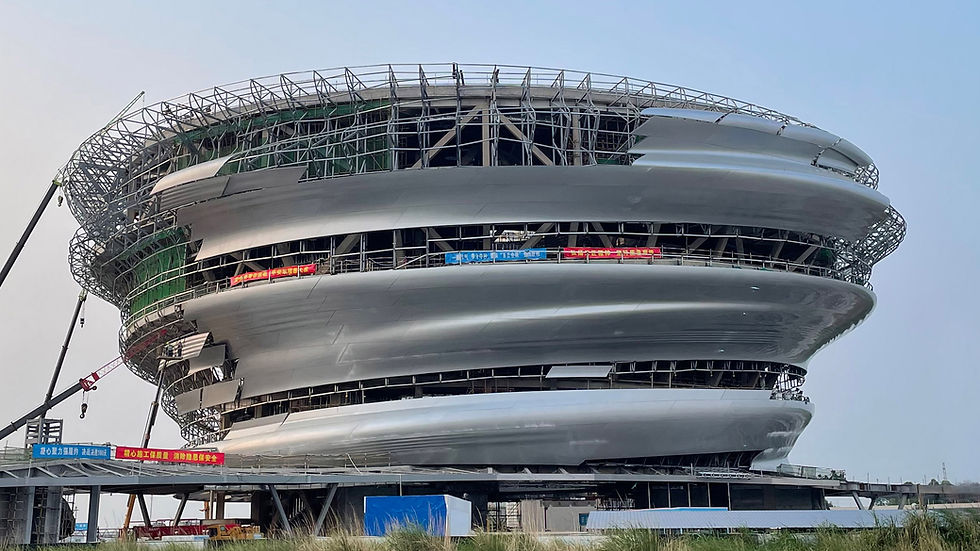
The museum occupies approximately 46,000 square meters on a 40,000-square-meter waterfront site. Its position near wetlands and tropical landscapes has strongly influenced the design language. Rather than imposing a rigid geometric structure onto the site, MAD Architects developed an organic form inspired by atmospheric movement, clouds, ocean currents, and the tropical climate of Hainan Island. The result is a building that appears fluid and continuously in motion.
Ma Yansong described the museum as an architectural interpretation of “flow and chaos,” where spaces blend into one another without abrupt separations. This philosophy is observable in the building’s continuous circulation paths, spiral ramps, curved atrium walls, and uninterrupted façade surfaces. The structure avoids conventional rectilinear forms and instead embraces smooth transitions between interior and exterior environments.
The museum resembles a silver cloud emerging from the landscape. Its exterior envelope spirals upward in concentric horizontal bands that wrap around the structure. These bands create deep overhangs and shaded areas that help moderate solar heat gain in Hainan’s humid tropical climate.
Visitor Experience and Exhibition Strategy
The building’s central atrium functions as the heart of the project. Visitors ascend to upper levels before gradually descending through exhibitions along a continuous circulation route. This approach transforms the visitor experience into a spatial journey rather than a sequence of disconnected rooms. Large circular openings within the atrium create visual connections between floors, allowing natural light to penetrate deep into the building.
One of the museum’s most iconic interior elements is the suspended whale sculpture beneath the main skylight. This installation symbolizes Hainan’s relationship with the ocean while reinforcing the immersive nature of the museum experience.
Relationship to the Landscape
The Hainan Science Museum was designed with strong ecological considerations due to its proximity to the Wuyuan River National Wetland Park. Rather than constructing a conventional urban object isolated from nature, MAD Architects integrated landscape, water, and circulation into a unified composition.
Reflecting pools surrounding the structure amplify the metallic façade's floating appearance while also assisting with passive cooling. Curving pedestrian paths connect the museum to gardens and outdoor educational spaces. The low horizontal geometry preserves visual continuity between the city and wetlands while minimizing disruption to the surrounding ecosystem.
The project also reflects China’s broader urban development strategy in Hainan Free Trade Port, where science, tourism, and ecological planning are increasingly integrated into large public developments.
Structural Engineering and Construction
The engineering complexity of the Hainan Science Museum is substantial. The spiraling geometry required extensive digital modeling and advanced fabrication techniques to coordinate the façade, steel framing, and structural cores.
The museum utilizes three major reinforced concrete core structures that support large column-free exhibition spaces. This strategy allows flexible gallery layouts and uninterrupted public circulation. The absence of numerous interior columns contributes to the open spatial experience and permits large-scale installations.
The curved exterior shell required custom-engineered façade systems. More than 843 fiberglass reinforced plastic panels were fabricated specifically for the project. These panels incorporate water-directing grooves and open-joint systems designed to address Hainan’s heavy rainfall and humid climate conditions.
Steel space frame systems support the upper spiraling structure while large cantilevered sections create shaded public plazas below. The integration of structural systems with architectural form demonstrates a high level of coordination between architects, engineers, and fabricators.
Construction began in late 2021, with the main structural framework completed in 2023. Curtain wall installation and landscape construction continued through 2024 and 2025 before the museum opened to the public in 2026.
Sustainability Features
Although visually futuristic, the Hainan Science Museum incorporates several passive environmental strategies. The building’s deep overhangs reduce direct solar exposure while allowing shaded outdoor circulation. Reflecting pools surrounding the museum assist with evaporative cooling in the tropical climate.
The fiberglass reinforced façade panels were engineered to handle intense humidity, rainfall, and salt exposure associated with Hainan’s coastal environment. The museum’s orientation and curving geometry help optimize airflow around the structure.
Natural daylighting significantly reduces energy demand in major public areas. Large glazed sections are carefully recessed beneath overhangs to minimize heat gain while maintaining transparency between interior and exterior spaces.
Landscape integration also plays a major role in environmental performance. Native vegetation and water-sensitive planning help maintain ecological continuity with adjacent wetlands.
Cultural and Urban Significance
The Hainan Science Museum reflects China’s growing investment in science education, cultural infrastructure, and iconic civic architecture. The project serves multiple purposes simultaneously: museum, educational center, tourism destination, and symbolic urban landmark.
The museum contributes to the transformation of Hainan into a globally recognized innovation and tourism region. Its futuristic form aligns with the Chinese government’s broader ambitions to position Hainan as an international free trade and technology hub.
Architecturally, the museum continues MAD Architects’ ongoing exploration of emotionally expressive public architecture. Unlike many technologically driven buildings that emphasize pure efficiency, the Hainan Science Museum seeks to create emotional engagement through spatial fluidity, light, movement, and sensory experience.
The project also expands the dialogue surrounding contemporary Chinese architecture. Rather than replicating Western skyscraper typologies, MAD Architects developed a distinctly sculptural and landscape-oriented approach that draws inspiration from natural systems and traditional Chinese philosophical relationships between humanity and nature.
Materials and Construction Cost Specifications
Architect: MAD Architects, led by Ma Yansong
Location: Haikou, Hainan Province, China
Project Area: Approximately 46,000 square meters
Site Area: Approximately 40,000 square meters
Floors: Six levels, including underground spaces
Structural System: Reinforced concrete cores with steel space frame superstructure
Façade Material: Fiberglass reinforced plastic panels, aluminum systems, high-performance glazing
Number of Façade Panels: Approximately 843 custom-fabricated panels
Interior Materials: White composite wall systems, terrazzo flooring, steel railings, acoustic ceiling systems, glass curtain walls
Roof System: Curved steel frame with integrated skylight systems
Landscape Features: Reflecting pools, wetlands integration, tropical planting, pedestrian plazas
Sustainability Features: Passive solar shading, natural daylighting, evaporative cooling, water management systems
Main Contractor: China Construction Eighth Engineering Division Corp., Ltd.
Estimated Construction Cost: Estimated between $180 million and $250 million USD based on comparable Chinese museum developments and reported investment figures.
Reported 2022 Investment Allocation: Approximately 345 million yuan invested during the active construction phase.
Conclusion
The Hainan Science Museum stands as one of the most visually ambitious museum projects completed in China during the 2020s. Through its spiraling metallic form, immersive public spaces, and environmentally integrated design, the project demonstrates how architecture can simultaneously function as infrastructure, sculpture, and educational space.
MAD Architects successfully created a museum that blurs the boundary between nature and technology. The project transforms scientific education into a spatial and emotional experience while reinforcing Hainan’s evolving role within China’s broader economic and cultural transformation.
Rather than relying solely on technological spectacle, the Hainan Science Museum emphasizes movement, atmosphere, light, and human experience. This balance between futuristic form and ecological sensitivity makes the project one of the most important contemporary museum buildings in Asia.
Works Cited
[1.] “Hainan Science Museum / MAD Architects.” ArchDaily, 18 May 2026.
[2.] ArchDaily interview with Ma Yansong regarding Hainan Science Museum concept, 2026.
[3.] Designboom. “MAD Builds Hainan Science Museum with Spiraling Metallic Structure.” 2026.
[4.] Arch2O. “MAD Shares Construction Milestones for Hainan Science and Technology Museum.” 2025.
[5.] e-architect. “Hainan Science Museum Construction Update.” 2024.
[6.] Arch2O. “Hainan Science and Technology Museum Visitor Experience Strategy.” 2025.
[7.] Comparative analysis based on museum construction cost benchmarks in China and the reported project scale.
[8.] Hainan Government News. “Construction of Hainan Science and Technology Museum in Full Swing.” 2023.
Site Plan Rendering of entrance Perspective view Interior Atrium Interior Perspective Interior Perspective Construction Photo Evening perspective


Comments