
From Smart Building to Grid Resource

Why Demand Flexibility Is Becoming a Core Building Specification for Smart Buildings

Why it matters | What AEC teams should do |
Buildings are becoming controllable grid resources, not only efficient loads. | Specify metering, controls, cybersecurity, commissioning, and handover requirements early. |
Market forecasts differ, but all point toward growth in integrated smart-building systems. | Treat market estimates as directional; verify local tariffs and program rules before claiming ROI. |
Executive Introduction
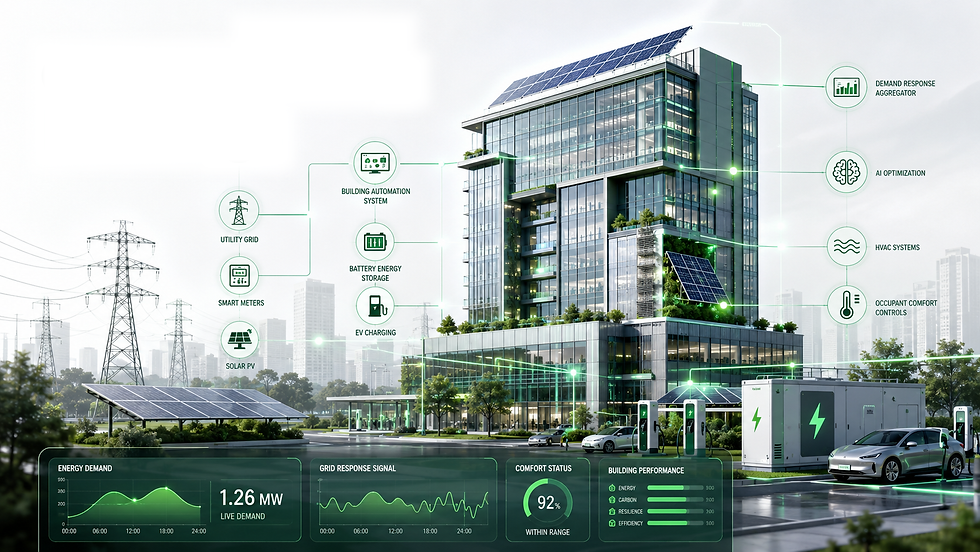
The smart building conversation is moving beyond dashboards, occupancy sensors, and app-based comfort controls. The next stage is more operational: buildings are being asked to act as flexible energy resources. A grid-interactive efficient building, often shortened to GEB, is not simply an efficient building with automation. It is a building that can reduce, shift, modulate, or sometimes generate electricity in response to utility prices, grid needs, carbon signals, resilience events, or owner-defined operating priorities. That distinction matters because DOE states that buildings use 74 percent of electricity in the United States and account for about $370 billion in annual energy costs. [1]
For architects, engineers, owners, contractors, and facility teams, the practical implication is direct: demand flexibility should be treated as a design and specification issue, not a software feature added after occupancy. A building that can trim peak loads, pre-cool before expensive hours, dim lighting within acceptable comfort limits, orchestrate EV charging, and dispatch storage is not just saving energy. It is becoming part of the power system. [1] [ 5]
Market Relevance
Commercial forecasts continue to show strong growth in smart building technology, but the numbers vary because research firms define the market differently. Grand View Research projected the global smart building market to reach $554.02 billion by 2033, with an 18.9 percent CAGR from 2026 to 2033. Fortune Business Insights valued the market at $143.00 billion in 2025 and projected it to reach $691.56 billion by 2034, with an 18.70 percent CAGR. MarketsandMarkets, using a narrower or differently segmented scope, estimated $121.57 billion in 2025 and $204.43 billion by 2032, with a 9.0 percent CAGR. [2] [3] [4]
Those differences should not be read as a single consensus forecast. They are a useful warning about scope. Some forecasts emphasize security, access control, workplace systems, and network management. Others include energy management, integration services, software platforms, and analytics. For the AEC audience, the better takeaway is that energy management, system integration, cybersecurity, analytics, and connected controls are becoming mainstream procurement categories rather than experimental technology allowances. [2] [3] [4]
Grid pressure reinforces the trend. DOE’s virtual power plant work describes VPPs as aggregations of distributed energy resources, including rooftop solar, batteries, EV chargers, smart buildings, equipment controls, and flexible commercial and industrial loads. DOE estimated that deploying 80 to 160 GW of VPPs by 2030 could reduce U.S. grid costs by about $10 billion per year. That is a national-scale scenario, not a guaranteed building-level ROI, but it explains why utilities, aggregators, owners, and technology vendors are paying attention. [5]
Technology Explanation
A grid-interactive, efficient building starts with good conventional performance: envelope quality, HVAC efficiency, lighting efficiency, commissioning, and controls that work in normal daily operation. Flexibility is then layered on top. The core functions are load shedding, load shifting, load modulation, and generation or storage dispatch. Load shedding temporarily reduces demand. Load shifting moves energy use from one time to another. Load modulation adjusts demand more continuously. Dispatch uses batteries, solar, thermal storage, or managed EV charging where equipment and contracts allow. [5] [6]
NREL’s study of large office buildings modeled practical measures, including lighting efficiency, lighting demand flexibility, cooling efficiency, and cooling demand flexibility. The study modeled lighting demand flexibility as a 30 percent reduction in lighting load during peak hours in occupied spaces and a 60 percent reduction in unoccupied spaces, while maintaining safety and comfort thresholds. Cooling flexibility involved global temperature adjustments during peak hours, with summer setpoints rising from 75 to 80 degrees Fahrenheit in the modeled case. These are not universal prescriptions; they show what demand flexibility looks like in engineering terms: defined sequences, limits, schedules, comfort constraints, and measurable load impacts. [6]

Application in Architecture, Engineering, and Construction
The most important design shift is timing. Flexibility requirements need to appear in owner project requirements, basis-of-design narratives, control specifications, commissioning plans, and digital handover packages. If they are introduced after substantial completion, the project team may discover that meters lack interval data, controls are not sufficiently granular, equipment is not addressable, or the network architecture blocks secure external signals. The cost of solving those problems late is usually higher than the cost of designing the pathways, points, and responsibilities early. [6] [8]
OpDez Architecture is already incorporating this shift into its work. Through its NexGen Smart Buildings framework, the firm considers building performance a systems-level architectural and engineering challenge, rather than a late-stage technology addition. The NexGen approach focuses on a controls-ready architecture, a BAS/BMS strategy, metering points, sensor placement, data pathways, energy systems, microgrid coordination, digital twin analytics, and an operations-centered handover. For owners and developers assessing grid-interactive buildings, this is significant because demand flexibility relies on integrated design choices across architecture, MEP engineering, controls, metering, cybersecurity, commissioning, and facility operations. [14] [15] [16] [17] [18]
Architects influence flexibility through envelope performance, daylighting, solar control, thermal mass, space planning, and equipment-room coordination. Mechanical engineers define the controllable end uses: air handlers, chillers, heat pumps, terminal units, dedicated outdoor air systems, thermal storage, and economizer strategies. Electrical engineers coordinate metering, switchgear, panel-level visibility, photovoltaics, batteries, EV charging, and emergency power interactions. Technology consultants and controls contractors define the data architecture, protocols, naming conventions, trend logs, and integration points. [6][ 9] [10]
Contractors and commissioning agents become central because demand flexibility depends on functional performance, not just installed devices. A building may include the right controllers, sensors, and meters, but still fail to respond predictably if sensors are miscalibrated, schedules are overridden, trend logs are incomplete, control loops are unstable, or tenant comfort constraints are not protected. The commissioning scope should therefore test both ordinary efficiency sequences and event-based operating modes. [6] [8]
Cost Considerations
Cost evidence is strongest for component technologies, analytics, and modeled value, not for one universal GEB premium. Project cost depends on whether the building is new construction or retrofit, whether it already has a modern BAS, how many points must be integrated, and whether the scope includes submeters, analytics, batteries, EV charging, cybersecurity upgrades, cloud services, or utility program enrollment. For budget planning, owners should separate base efficiency work, controls modernization, DER integration, software licensing, commissioning, and ongoing operator labor, rather than treating “smart building” as a single line item. [7] [8]
For automated fault detection and diagnostics, a 2020 LBNL-linked study reported that 27 FDD users had median costs of $8 per monitoring point for base software, $2.70 per point for annual recurring software, and $8 per point for annual labor, with a median implementation size of about 1,300 points. That is a useful budget context, but it is not a complete GEB cost model. It covers FDD users, not every controls retrofit, not every building type, and not the cost of deeper DER integration. [7]
Utility and market revenue should also be treated carefully. LBNL’s 2024 report on demand flexibility programs and rates found 148 programs and 93 rates in its reviewed U.S. dataset, but it also warned that public outcome data on enrollment, participation, and savings remain insufficient to connect program design reliably to performance. Incentives can improve project economics, but the owner still needs to verify the local tariff, event rules, customer baseline method, dispatch obligations, measurement requirements, and operational limits before counting revenue in a pro forma. [8]
Material and System Specifications
A robust grid-interactive building specification should include interval-grade whole-building metering, submeters for major loads, a BAS or BMS capable of supervisory control, open or well-documented interfaces, secure remote access, trend logging, analytics, operator dashboards, and a demand-response interface. It should also define who owns the point list, who maintains the naming convention, who receives alarms, who approves external control requests, and how overrides are logged. These are governance questions as much as technical questions. [8] [10] [11]
At the field level, specifications should identify sensors, actuators, controllers, meters, gateways, and sequence requirements. For HVAC, that may include zone temperature, supply air temperature, valve and damper position, fan status, fan speed, chilled-water or hot-water data, and equipment runtime. Lighting may include networked lighting controls, occupancy sensors, daylight-responsive controls, and dimming zones. For DERs, it may include PV inverter data, battery state of charge, EV charger load management, interconnection constraints, and event response limits. [6] [9] [10]
The owner should require a digital handover package that is useful to facility staff rather than merely completed on paper. That package should include the controls narrative, final point list, as-built network architecture, cybersecurity roles, trend-log schedule, alarm hierarchy, utility or aggregator interface requirements, test scripts, and operator training materials. Without those details, the building may be connected but not actually operable as a flexible resource. [8] [10] [11]
Standards and Codes
Several standards and frameworks matter, but they do different jobs. ANSI/ASHRAE/IES Standard 90.1 remains a major commercial energy standard, and ASHRAE states that the 2025 edition incorporates 105 addenda, advances efficiency, expands compliance options, and clarifies renewable energy provisions. Standard 90.1 is not a comprehensive smart-building interoperability standard, but it increasingly sets the baseline for controls, energy monitoring, and energy performance in commercial buildings. [9]
OpenADR addresses demand-response communication. The OpenADR Alliance states that OpenADR 3 is not intended to replace the OpenADR 2.0a or 2.0b profile specifications, but to provide an additional simplified way to add OpenADR functionality. That distinction matters for specifications because a team should verify which protocol version a utility, aggregator, or certified product actually requires before naming it in the project manual. [10]
Cybersecurity should be treated as core infrastructure. NIST released Cybersecurity Framework 2.0 on February 26, 2024, expanding its applicability beyond critical infrastructure and adding greater emphasis on governance and supply chains. For buildings, this supports a practical project requirement: smart-building OT should have defined ownership, segmentation, access control, patching responsibilities, vendor management, and incident-response procedures. These requirements belong in project governance and service agreements, not only in IT policy binders. [11]
FERC Order No. 2222 is important in the United States because it seeks to enable distributed energy resource aggregations to participate in regional wholesale electricity markets. It does not mean every building can already participate everywhere. Market access still depends on regional implementation, utility rules, metering, telemetry, aggregation models, and building-level economics. That makes local due diligence essential before promising VPP revenue to an owner. [12]
Case Studies and Examples
The strongest public evidence currently consists of modeled studies, program landscape research, and operational analytics. NREL’s large-office study is a modeled analysis rather than a completed-project case study, but it is valuable because it translates flexibility into specific lighting and cooling actions that can be evaluated for their effects on bills, emissions, and power-system impacts. LBNL’s program report is also not a building case study; its value lies in showing both momentum and reporting gaps in demand-flexibility programs. [6] [8]
The FDD study is closer to operational evidence because it gathered cost data from users applying diagnostics across real buildings, but it should not be overgeneralized. Savings depend on whether faults are corrected, whether facility staff have time to act, whether analytics are tuned, and whether the building is already well commissioned. A smart-building platform that finds faults but cannot trigger maintenance action is an information system, not an outcome system. [7]
Future Outlook
The smart building of the next decade will be judged less by how many systems it connects and more by how reliably it can deliver outcomes: lower energy cost, lower peak demand, better comfort, cleaner operations, faster fault resolution, safer OT networks, and verifiable load flexibility. AI will likely improve forecasting, anomaly detection, and supervisory optimization, but the foundation remains practical: good sensors, working controls, clear sequences, secure networks, usable data, and trained operators. [5] [6] [7] [11]
For AEC teams, the opportunity is to make demand flexibility a normal design deliverable. That means asking during schematic design which loads are flexible, which are critical, which can be shifted, which require tenant consent, and which must remain untouched. It means treating the building not only as an asset that consumes energy, but as infrastructure that can coordinate with the grid while still serving the people inside. [6] [8] [12]
Download Current Report

MLA Works Cited
[1] U.S. Department of Energy. “Buildings Energy Efficiency.” Energy.gov, accessed 30 May 2026. https://www.energy.gov/topics/buildings-energy-efficiency
[2.] Grand View Research. “Smart Building Market Size and Share, Industry Report, 2033.” Grand View Research, 2026. https://www.grandviewresearch.com/industry-analysis/global-smart-buildings-market
[3.] Fortune Business Insights. “Smart Building Market Size, Share and Growth Report, 2034.” Fortune Business Insights, 2026. https://www.fortunebusinessinsights.com/industry-reports/smart-building-market-101198
[4.] MarketsandMarkets. “Smart Buildings Market by Solution, Building Type, and Region, Global Forecast to 2032.” MarketsandMarkets, 2026. https://www.marketsandmarkets.com/PressReleases/smart-building.asp
[5] U.S. Department of Energy. “DOE Releases New Report on Pathways to Commercial Liftoff for Virtual Power Plants.” Energy.gov, 12 Sept. 2023, accessed 30 May 2026. https://www.energy.gov/edf/articles/doe-releases-new-report-pathways-commercial-liftoff-virtual-power-plants
[6] McLaren, Joyce, Thomas Bowen, and Chioke Harris. Efficiency and Demand Flexibility in Large Office Buildings: The Potential for Cost Savings and CO2 Reductions from Lighting and Cooling Measures. National Renewable Energy Laboratory, 2023. https://www.nrel.gov/docs/fy23osti/83552.pdf
[7] Lin, Guanjing, Hannah Kramer, and Jessica Granderson. “Building Fault Detection and Diagnostics: Achieved Savings, and Methods to Evaluate Algorithm Performance.” Building and Environment, vol. 168, Jan. 2020. Lawrence Berkeley National Laboratory summary accessed 30 May 2026. https://smartersmallbuildings.lbl.gov/publications/building-fault-detection-and
[8] Murphy, Sean, Cesca Miller, Jeff Deason, Diana Dombrowski, and Portia Awuah. The State of Demand Flexibility Programs and Rates. Lawrence Berkeley National Laboratory, Aug. 2024. https://eta-publications.lbl.gov/sites/default/files/df_programs_and_rates_draft_final_20240814.pdf
[9] ASHRAE. “ANSI/ASHRAE/IES Standard 90.1.” ASHRAE, accessed 30 May 2026. https://www.ashrae.org/technical-resources/bookstore/standard-90-1
[10] OpenADR Alliance. “OpenADR 3 Introduction and Certification Program.” OpenADR Alliance, accessed 30 May 2026. https://www.openadr.org/openadr-3-0
[11] National Institute of Standards and Technology. “NIST Releases Version 2.0 of Landmark Cybersecurity Framework.” NIST, 26 Feb. 2024. https://www.nist.gov/node/1840561
[12] ASHRAE. “Protecting Building Automation Systems with BACnet Secure Connect.” ASHRAE, accessed 30 May 2026. https://www.ashrae.org/news/esociety/protecting-building-automation-systems-with-bacnet-secure-connect
[13] Federal Energy Regulatory Commission. “FERC Order No. 2222 Explainer: Facilitating Participation in Electricity Markets by Distributed Energy Resources.” FERC, accessed 30 May 2026. https://www.ferc.gov/ferc-order-no-2222-explainer-facilitating-participation-electricity-markets-distributed-energy
[14.] OpDez Architecture. “NexGen Overview.” OpDez Architecture, accessed 30 May 2026. https://www.opdez-architecture.com/nexgen-overview
[15.] OpDez Architecture. “BAS / BMS.” OpDez Architecture, accessed 30 May 2026. https://www.opdez-architecture.com/bas-bms
[16.] OpDez Architecture. “Microgrid + Controls.” OpDez Architecture, accessed 30 May 2026. https://www.opdez-architecture.com/microgrid-controls
[17.] OpDez Architecture. “Digital Twin + Analytics.” OpDez Architecture, accessed 30 May 2026. https://www.opdez-architecture.com/digital-twin-analytics
[18.] OpDez Architecture. “NexGen Buildings / Prototypes.” OpDez Architecture, accessed 30 May 2026. https://www.opdez-architecture.com/nexgen-buildings-prototypes


Comments