
Grid-Interactive Efficient Buildings Are Becoming the Practical Next Step in Smart Buildings

Updated: Jun 20
Introduction
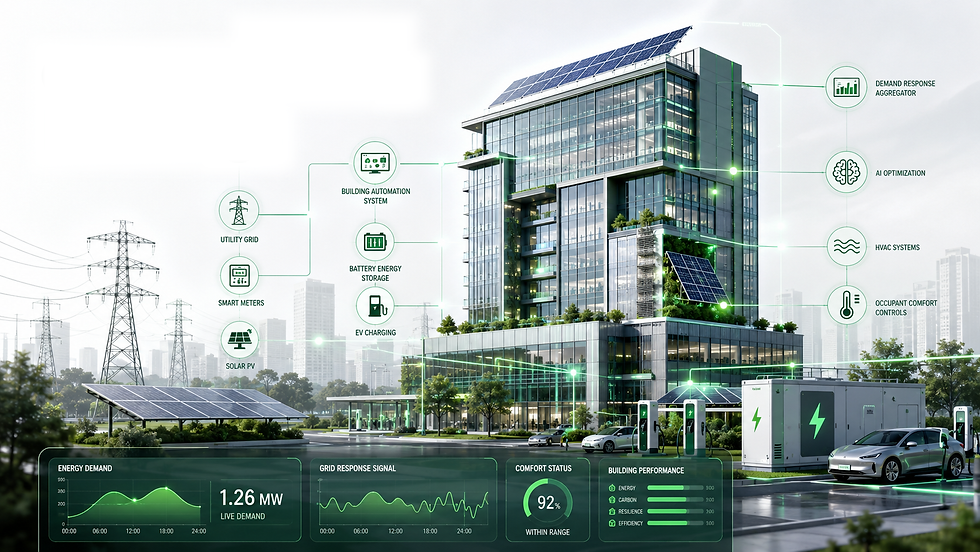
For much of the last decade, the phrase smart building usually referred to better dashboards, more sensors, and tighter integration of HVAC, lighting, access control, and analytics. In 2026, that definition is widening. A growing share of building owners, utilities, and regulators are now interested in whether buildings can act as flexible grid assets as well as efficient places to live and work. That shift matters because buildings already sit at the center of electricity demand. The U.S. Department of Energy has repeatedly noted that buildings consume roughly three-quarters of U.S. electricity, and its grid-interactive efficient buildings work treats that demand as a resource that can be shaped, not just reduced [1], [2].
The practical term for this next layer of capability is the grid-interactive efficient building, or GEB. DOE defines it as an energy-efficient building that uses smart technologies and distributed energy resources to continuously co-optimize energy costs, grid services, and occupant needs. The concept sounds ambitious, but the basic logic is straightforward: once a building has good controls, metering, and communications, it can respond to prices, demand-response events, carbon signals, or resilience needs with much greater precision than a conventional building [3], [4].
Market relevance of Smart Buildings
The commercial case is no longer just theoretical. Mainstream market researchers still disagree on the exact size of the broader smart building market, but they agree on the direction. Grand View Research estimated the global smart building market at USD 141.79 billion in 2025 and projected it to reach USD 554.02 billion by 2033. Fortune Business Insights placed the 2025 market slightly higher, at USD 143.00 billion, and projected it to reach USD 691.56 billion by 2034. The gap between those forecasts is a useful reminder that headline market numbers vary with category definitions, forecast windows, and the consistency with which software, services, security, and infrastructure layers are counted.
Even so, both forecasts point to fast double-digit growth rather than a niche market [5], [6].
A second market signal is the maturing landscape of demand flexibility around buildings. Lawrence Berkeley National Laboratory reported in August 2024 that it had compiled a U.S. dataset of 148 demand-flexibility programs and 93 rates from utility tariffs and program offerings. That does not mean every program is large or easy to monetize. Still, it does show that owners are dealing with an expanding operational environment in which tariffs, incentives, and event structures increasingly reward flexible load. In other words, the value stack around smart buildings is becoming more time-sensitive [7].
Technology explanation
A useful way to understand GEBs is to separate the stack into four layers: efficient equipment, sensing and controls, interoperability, and flexible distributed energy resources. DOE's 2024 guide for federal and commercial facilities describes four core demand-management strategies: efficiency, load shed, load shift, and modulation. Efficiency lowers total use. Load shed cuts are used for a short period, often during a peak event. Load-shift moves are used to improve timing, such as pre-cooling before a peak-price window. Modulation is a faster, finer-grained adjustment that can help balance services [4].
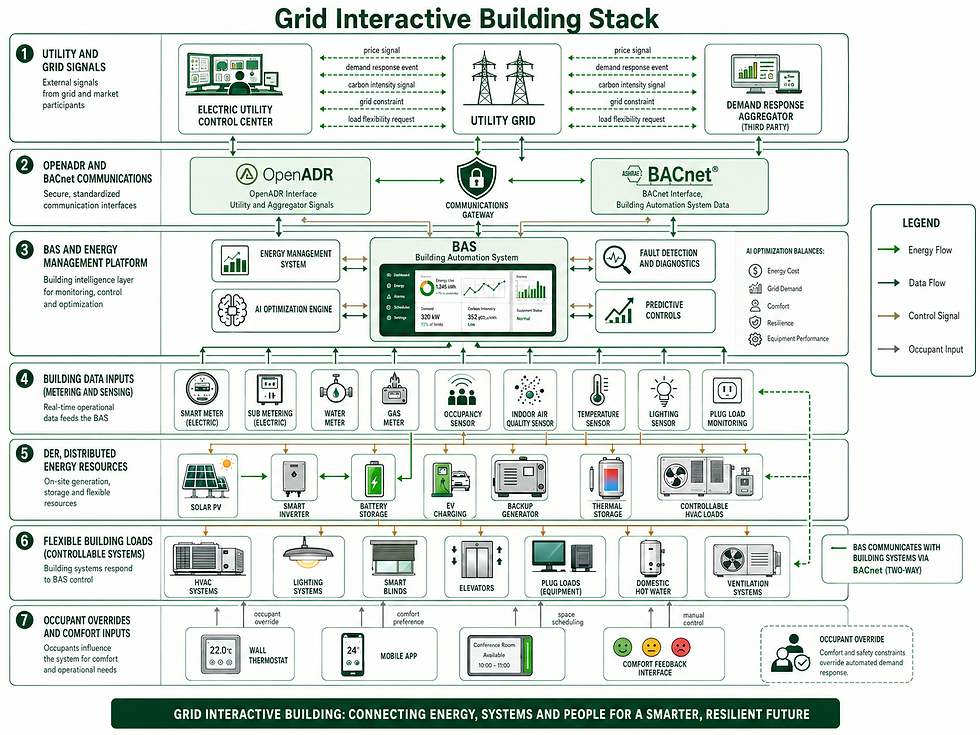
In practice, the most important systems are familiar to architects, engineers, and facility teams. Building automation systems coordinate HVAC sequences, zone schedules, and economizer behavior. Lighting controls trim or dim the electrical load quickly. Smart meters, submeters, and interval data provide the measurement backbone. Thermal or battery storage enables the storage of inexpensive or low-carbon electricity for later use. On-site photovoltaics and EV charging create both opportunities and complexities because unmanaged DER can exacerbate peaks, while orchestrated DER can reduce them. DOE's technology prioritization work suggests that for office, laboratory, and data-center-like uses, HVAC controls, thermal storage, lighting controls, and computing controls tend to offer especially meaningful flexibility potential because they target major end uses [4].
Interoperability is what turns this hardware into a reliable system architecture. BACnet remains a backbone standard for building automation, and ASHRAE describes it as a vendor-independent communications protocol for HVAC, lighting, access control, elevators, security, and fire systems. For external grid and price signals, OpenADR remains a key mechanism. The OpenADR Alliance describes OpenADR as a standardized, interoperable message format for automated demand response and DER management, and it notes that the IEC approved the OpenADR 2.0 profile as IEC 62746-10-1 in 2018. The newer OpenADR 3 framework adds a simplified API-based path for current and emerging use cases rather than replacing OpenADR 2 outright [8], [9], [10].
Application in architecture, engineering, and construction
For AEC teams, the lesson is that GEB performance is largely decided before occupancy. A building that waits until late in construction to consider demand flexibility usually ends up with a fragmented controls stack, incomplete point mapping, limited submetering, and handoff problems among MEP, IT, and operations. Early design work should therefore treat flexibility as an owner project requirement, not a post-occupancy add-on. That means identifying controllable loads, defining what data must be trended, requiring interoperable protocols, and writing sequences of operation that can support both comfort and load response [3], [11].
This also changes the specification culture. Engineers may need to specify interval metering, gateways, network segmentation for OT systems, override hierarchies, trend-log retention, and control points for EV charging, batteries, or thermal storage. Contractors need clarity on integration scope, who owns functional testing, and what constitutes an acceptable handover. Commissioning agents increasingly need to verify not only that equipment meets design intent, but that the building can actually receive a signal, execute a response, and return to normal without destabilizing operations. Those are not glamorous tasks, but they determine whether a smart building can earn flexibility value in the real world.
Cost considerations
Cost considerations often undermine credibility in smart building discussions, so careful budgeting is essential. Public sources do not offer a single definitive price for making a building grid-interactive. Expenses vary based on factors such as building size, age, control system maturity, existing metering, tenant preferences, the scope of integration, and whether the work is combined with capital renewal. The DOE's 2024 federal guide thus categorizes costs broadly instead of providing precise figures. It describes low-cost options as under USD 25,000, medium-cost between USD 25,000 and USD 50,000, and high-cost over USD 50,000, based on an average 40,000-square-foot federal commercial building and using mostly 2020 cost data. While this classification is helpful, it should be viewed as a preliminary screening tool rather than a definitive bid estimate [4].
A more defensible owner conversation starts with cost drivers. If a building already has a modern BAS, interval utility data, and decent point-level visibility, the next step may be a relatively modest controls upgrade, recommissioning effort, or tariff-response sequence. If the building lacks those basics, costs rise quickly because the project becomes a digital infrastructure retrofit. Envelope-linked flexibility measures can be expensive; DOE's guide, for example, cites dynamic glazing at about USD 80 per square foot on average, making it a very different decision from adding software logic to an existing air-side system. On the value side, owners should examine avoided demand charges, participation incentives, reduced peak exposure, resilience benefits, and energy savings collectively rather than asking a single measure to justify the whole stack [4].
Material and system specifications
From a specification standpoint, a credible GEB-ready building typically requires several key ingredients. First, it needs controllable end uses: variable-speed HVAC equipment, lighting controls, and, where relevant, controllable water heating, refrigeration, or plug-load strategies. Second, it needs measurement: utility meters plus submeters or interval data streams that can verify what happened during an event. Third, it needs software layers that can coordinate schedules, optimize setpoints, and preserve operator override authority. Fourth, it requires secure communication between the building and external actors, such as utilities, aggregators, or DER platforms [4], [8], [9].
The implications for replacement and maintenance are also important. More sensors and gateways increase calibration, firmware, and cybersecurity obligations. A building that depends on cloud analytics or external orchestration should define fail-safe behavior, local fallback modes, and long-term support responsibilities. In short, the specification is not only about what gets installed. It is also about how the system behaves when connectivity is interrupted, tariffs change, or operators need to take manual control.
Standards and codes
Several standards and frameworks shape this field, even though no single document fully governs GEB deployment. ASHRAE Standard 90.1 remains the benchmark energy standard behind much commercial code development, and ASHRAE says the 2025 edition continues to expand efficiency expectations and compliance options. BACnet, under ANSI/ASHRAE 135, remains central to internal interoperability among building systems. PNNL's work on building energy codes and GEBs adds an important policy nuance: it argues that broader code treatment of grid-responsive measures will remain limited until those measures are more fully developed into ANSI-approved standards that code bodies can reference directly [8], [11], [12].
Cybersecurity now deserves equal billing with interoperability. NIST published CSF 2.0 on February 26, 2024, explicitly positioning it as a cross-sector framework for managing cybersecurity risk. For smart buildings, that matters because every new meter, gateway, BACnet/SC connection, cloud integration, or EV control endpoint expands the attack surface. A sophisticated demand-flexibility building that cannot be securely governed is not truly high performance. OT segmentation, identity management, patching responsibility, logging, and incident response should be considered design and procurement topics, not just IT afterthoughts [13].
Case studies and examples
The public case-study base is still thinner than the marketing volume in this space, but two federal examples cited by DOE are useful because they are presented as operational projects rather than conceptual pilots. DOE's 2024 guide says the Oklahoma City Federal Building showed that GEB-ready measures, including a PV array, lighting controls, BAS upgrades, battery storage, and advanced power strips, could be deployed with minimal investment at a 178,342-square-foot facility. The same guide cites the VA Carl T. Hayden Medical Center in Phoenix as an energy retrofit project that reduced energy consumption by 25 percent while using storage and on-site generation to shift load against time-of-use pricing and reduce demand charges across an 850,000-square-foot campus. These examples should not be overgeneralized, but they indicate the direction of travel: smart-building value is strongest when controls, DER, and tariff logic are coordinated [4].
Future outlook
The next few years will probably be less about futuristic building autonomy and more about operational discipline. Buildings that can combine efficiency, flexible control, secure communications, and verifiable performance will be better positioned for rising electrification, more volatile peak conditions, and greater utility interest in distributed flexibility. IEA's 2024 commentary argues that more efficient and flexible buildings are becoming important to clean energy transitions, and it notes a U.S. analysis suggesting widespread GEB adoption could cut peak demand by 116 gigawatts, roughly the output of more than 200 large power plants. That is an ambitious systems-level view, but it helps explain why the topic is moving from R&D into procurement, tariffs, and code conversations [14].
For owners, the near-term question is not whether every building needs a battery or a digital twin. It is whether each asset has the controls, metering, interoperability, and governance needed to respond intelligently to time, price, carbon, and reliability signals. For designers and operators, that is a much more practical and much more urgent brief.
Works Cited
Department of Energy. “Data and Analysis for Buildings Sector Innovation.” U.S. Department of Energy, accessed 28 May 2026, https://www.energy.gov/cmei/buildings/data-and-analysis-buildings-sector-innovation.
Department of Energy. “Grid-Interactive and Efficient Buildings are Emerging as Dynamic Solutions to Many Energy Challenges.” U.S. Department of Energy, 27 Mar. 2020, https://www.energy.gov/eere/articles/grid-interactive-and-efficient-buildings-are-emerging-dynamic-solutions-many-energy.
Department of Energy. “Grid-Interactive Efficient Buildings for Federal Agencies.” U.S. Department of Energy, accessed 28 May 2026, https://www.energy.gov/femp/grid-interactive-efficient-buildings-federal-agencies.
Nubbe, Valerie, April Weintraub, and Mark Butrico. Key Grid-Interactive Efficient Building Technologies for Federal and Commercial Facilities. U.S. Department of Energy, Sept. 2024, https://www.energy.gov/sites/default/files/2024-09/femp-key-geb-technologies-list.pdf.
Grand View Research. “Smart Building Market Size & Share | Industry Report, 2033.” Grand View Research, accessed 28 May 2026, https://www.grandviewresearch.com/industry-analysis/global-smart-buildings-market.
Fortune Business Insights. “Smart Building Market Size, Share & Growth Report [2034].” Fortune Business Insights, accessed 28 May 2026, https://www.fortunebusinessinsights.com/industry-reports/smart-building-market-101198.
Murphy, Sean, et al. The State of Demand Flexibility Programs and Rates. Lawrence Berkeley National Laboratory, Aug. 2024, https://smartersmallbuildings.lbl.gov/publications/state-demand-flexibility-programs-and.
ASHRAE. “ASHRAE Standard 135 A Data Communication Protocol for Building Automation and Control Networks (BACnet).” ASHRAE, accessed 28 May 2026, https://data.ashrae.org/BACnet/index.html.
OpenADR Alliance. “About OpenADR.” OpenADR Alliance, accessed 28 May 2026, https://www.openadr.org/about-us.
OpenADR Alliance. “OpenADR 3 Introduction and Certification Program.” OpenADR Alliance, accessed 28 May 2026, https://www.openadr.org/openadr-3-0.
Franconi, E. M., M. I. Rosenberg, and R. Hart. Building Energy Codes and Grid-Interactive Efficient Buildings: How Building Energy Codes Can Enable a More Dynamic and Energy-Efficient Built Environment. Pacific Northwest National Laboratory, 2021; web publication updated 15 Feb. 2024, https://www.pnnl.gov/publications/building-energy-codes-and-grid-interactive-efficient-buildings-how-building-energy.
ASHRAE. “ANSI/ASHRAE/IES Standard 90.1.” ASHRAE, accessed 28 May 2026, https://www.ashrae.org/technical-resources/bookstore/standard-90-1.
National Institute of Standards and Technology. The NIST Cybersecurity Framework (CSF) 2.0. NIST CSWP 29, 26 Feb. 2024, https://doi.org/10.6028/NIST.CSWP.29.
International Energy Agency. “More Efficient and Flexible Buildings Are Key to Clean Energy Transitions.” IEA, 4 Apr. 2024, https://www.iea.org/commentaries/more-efficient-and-flexible-buildings-are-key-to-clean-energy-transitions.



Comments